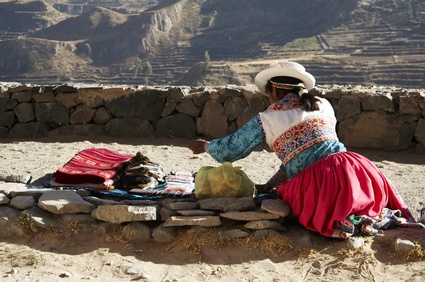
The Andes mountain range occupies the entire coastal strip, starting from Colombia down to Chile, touching along its course Ecuador, Bolivia, Paraguay and Argentina.
The Andes chain stretches from north to south along the whole western coastline of South America for a length of more than 7000 kilometres.
The environment of the Andean high plateau
is treeless and subject to extremely wide temperature swings. By day the beating sun fiercely scorches the earth, by night the bitter temperatures freeze the ground.
In this harsh mountain environment the destiny of the Indios of the Andes is written. They are people endowed with an exceptionally hardy physique, yet paradoxically they end up living a desperately poor and miserable life. The plateau offers few opportunities for development and the Andean peoples often lead a life of hardship, made of malnutrition, and are often forced into back-breaking labour. Because of this hostile environment, these people have turned into one of the physical wonders of the world, adapting in a unique way to the extremely harsh living conditions of high altitude.
On the plateau, at over 4000 metres, the atmospheric pressure is little more than half of what it is at sea level, and on most days of the year the temperature drops below zero. These harsh environmental conditions have meant that, over the course of biological
evolution, the Andean peoples have developed wonderful systems of adaptation. A stocky body, short and squat hands and feet to avoid useless heat loss, dark skin able to withstand and protect against the terrible ultraviolet rays found at high altitude. Since his extremities are supplied by many blood vessels, the Indio can walk barefoot on snow without suffering at all. The Indio has also developed larger than normal lungs and chest; his blood and tissues are able to use the oxygen in the air extremely efficiently. This structural difference in the lungs can also be found between Indios from the mountain areas and Indios living in the valleys, the plains and the coastal areas, who have a less expanded rib cage.
Despite all these extraordinary physical adaptations to high altitude, the life of the Andean Indio today is terribly hard, even though his ancestors, the Incas, once ruled these regions. The result of Spanish colonisation is that the Andean peoples today are mostly underdeveloped. Dysentery and whooping cough kill a high percentage of children, and adult life expectancy is anything but long.
Most of the Andean population lives in the valleys and on the plateaus at mid altitude, between 2250 and 3500 metres, that is in those places where the land is easier to farm, where the meltwater from the glaciers makes the soil wetter. They work mainly in the fields, growing potatoes, beans and quinoa seeds, a plant that is the staple food for many of these peoples. By raising animals such as the llama, the vicuña and the alpaca they obtain the precious wool with which they weave brightly coloured textiles.
Among the Andean peoples of Ecuador and Bolivia the growing and chewing of coca leaves has a particular importance: for more than three thousand years they have been part of the diet of these mountain peoples. This so controversial plant is, for the Andean peoples, at the centre of daily life, both for its medicinal effects and for the meaning it holds in religious rituals. The stimulating effect of the leaf helps the population through the gruelling hours of daily work on heights above 3000 metres, and it acts as a food supplement, improving general health. It is often used as a medicine against a great number of ailments: circulation problems, toothache, stomach ache, rheumatism, muscle cramps, altitude sickness. It is used to make herbal teas or is slowly sucked during working hours.
It would seem, however, that the indiscriminate use of this plant, although the amount of the well-known alkaloid is fairly minimal, considerably shortens the lives of the Indios, who rarely live beyond the age of forty.
As for the origin of the Andean peoples, it should be remembered that the Inca empire stretched along almost the whole of South America, ruling the present-day regions of Ecuador, Bolivia, Chile and Argentina. The prevailing culture, among the many Andean ethnic groups, is represented by the peoples who still today use the ancient “Quechua” language, that is the language spoken in the Inca empire. There are, however, in the most inaccessible recesses of the Andes, peoples who keep a language, traditions and culture of pre-Columbian origin. These are a great number of ethnic groups such as the Aymara, the Q'eros and many others, who until fairly recent times were persecuted.