Juniper has diuretic, antiseptic, balsamic, expectorant and stimulant properties.
Precisely because of these properties it was widely used in the past as an antidote against animal bites and poisons. It was also believed it could protect against the plague.
Another shrub of the Apennine pastures is the dog rose.
Photo gallery

Fact sheet
- Range and distribution
- It is perhaps the woody plant of the northern hemisphere with the most varied and widest range. It grows from the coasts up to high pastures, from the shores of the Mediterranean to the far north, in Europe, Asia and North America. In Italy it is very common and can be found between 0 and 1500 m a.s.l. Up to 3000 m a.s.l. you find the dwarf subspecies (J. communis var. montana Aiton), with a prostrate habit.
- Ecology
It has a wide variety of habitats: in open areas from the coasts to dry, stony pastures at altitude.
It spontaneously colonises very poor soils and is therefore essential in stabilising unstable slopes, but it spreads slowly.- Habit
It has a wide variety of habitats: in open areas from the coasts to dry, stony pastures at altitude.
It spontaneously colonises very poor soils and is therefore essential in stabilising unstable slopes, but it spreads slowly.- Leaves
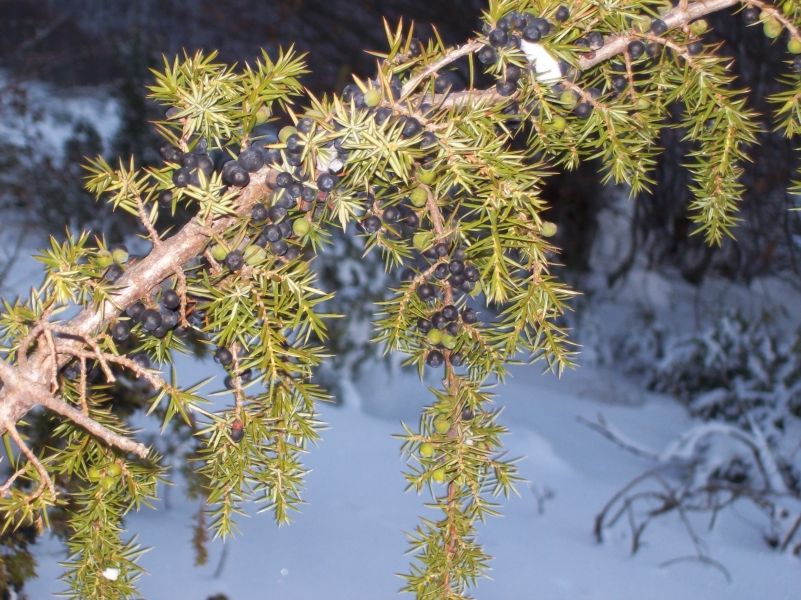
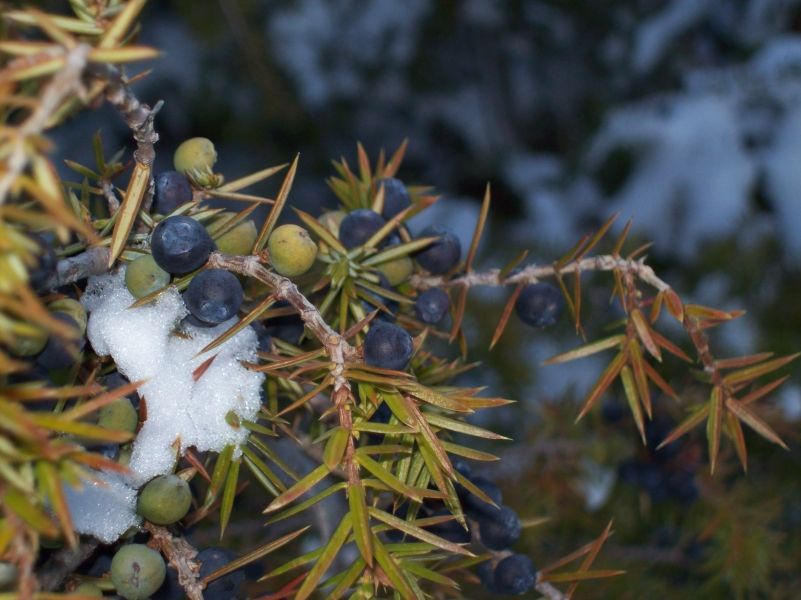
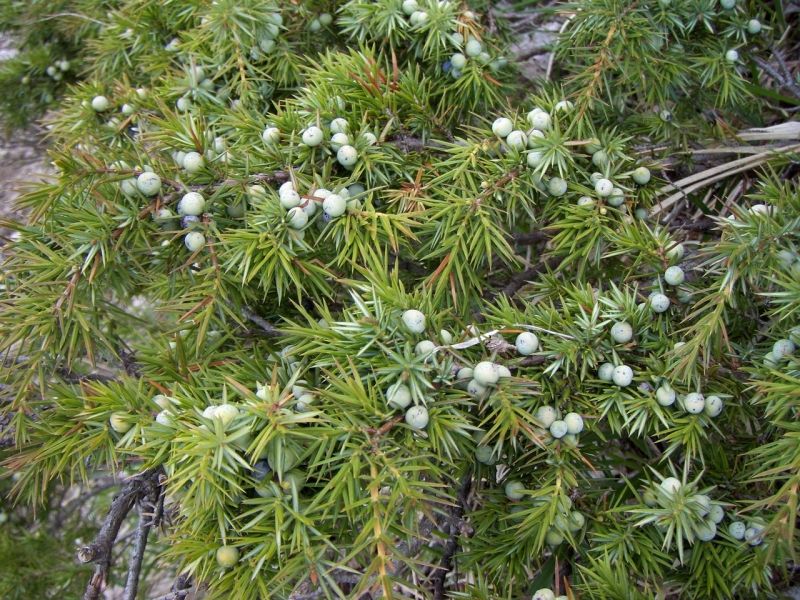
The leaves are linear, prickly and arranged in “whorls” of 3, about 1/2 cm in size, ovate-elliptic, shiny green with a broad white stripe on the upper surface.
- Flowers and fruit
It flowers between February and April.
The flowers are unisexual, generally borne on separate plants. The male cones are yellow and cylindrical; the female cones greenish.
The “coccole” or galbuli (the fruit of the juniper) are berry-like (about 6mm across), at first green and glaucous, then bluish-violet when ripe.- Bark
The stems are twisted and much branched, with reddish-brown bark that peels away with age in thin vertical strips.
- Uses
- Juniper has diuretic, antiseptic, balsamic, expectorant and stimulant properties. Precisely because of these properties it was widely used in the past as an antidote against animal bites and poisons. It was also believed it could protect against the plague. Today the leaves (for decoctions) and the fruits of the juniper are used. In particular the berries are widely used in cooking to flavour meat dishes, to make “gin” and digestive liqueurs, and to produce an oil used in medicine. The wood is durable and keeps a delicate, lasting fragrance. It is used to make small objects. The branches are also burnt to smoke and flavour cured meats.