The characteristic forest species of the montane belt are the beech, the silver fir, the Scots pine, the black pine and the laricio pine.
Accompanying these and sometimes forming stands of their own are the birch, the yew, the holly and some species of poplar and maple. The montane belt extends across the Alps and the Apennines as far as Sicily.
This wide extent gives it great variability and a wealth of ecosystems, which is expressed in the richness of its floristic composition. In fact the generally temperate climate, without periods of drought, allows the vegetation to grow luxuriantly. The forest of the montane belt is dense and tall. The undergrowth is rich in shade-loving (sciaphilous) species, while the vegetation of clearings is typically made up of tall grasses.
Natural scrub woodland is found naturally only in rocky cliff formations. Other types of scrub derive from human-induced degradation of more developed formations.
The montane belt
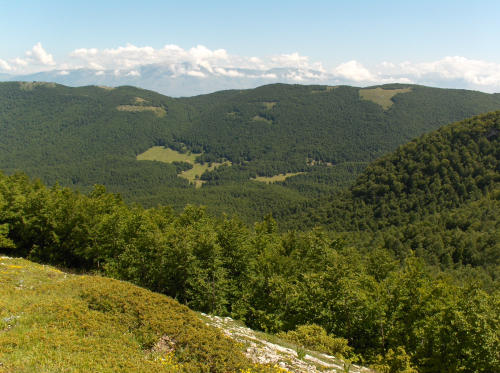
The characteristics of the montane belt are:
-
more favourable edaphic (soil) conditions. In fact sites with limitations are few. Arid conditions are concentrated only where soils are shallower and sunnier;
-
temperatures are mild, even though frosty days are not lacking;
-
snow is abundant but melts more quickly. In this belt there is the phenomenon of “heavy snow” (wet snow), which often causes trees to snap and split;
-
the growing season lasts around 100-180 days;
-
rainfall is higher. Depending on the character of the season, there are situations in which rainfall reaches on average 1200 mm a year. Associated with this are the formation of fog and the persistence of low cloud. These conditions of high atmospheric humidity are very favourable to broadleaved trees, but just as harmful to conifers, which are often subject to fungal diseases;
-
- winds are an important limit for tree vegetation. At higher altitudes further limiting factors are also the shortening of the growing season and physiological drought;
Sources:
Bernetti G., 1995, Selvicoltura Speciale, Utet – Turin
Pignatti S., 1998, I Boschi d’Italia, Utet – Turin
Going higher you pass into the subalpine belt.