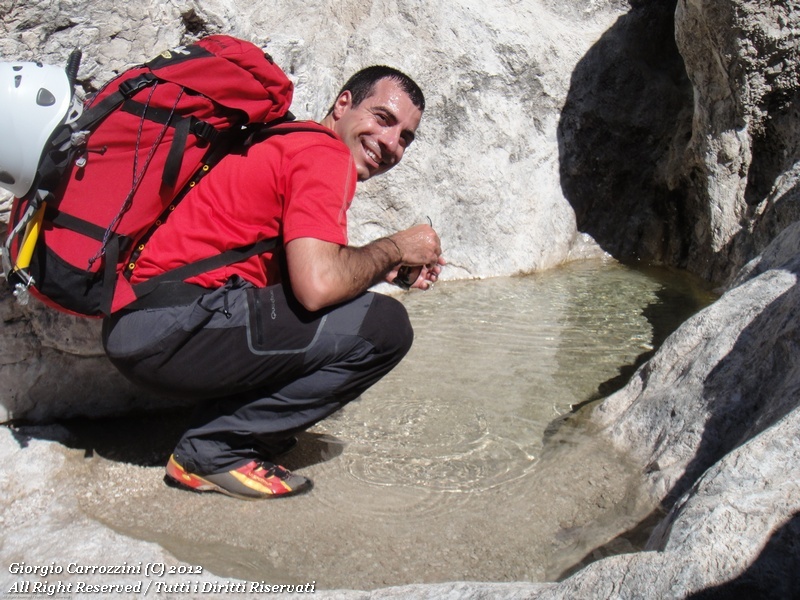
The climb up the Prena by the Via dei Laghetti (the “Little Lakes” route) is a spring classic of classics, when the meltwater from the snow fills a few small pools that form along the route.
The team is put together by the good Massimo N., who, to get some leg work in, whets the appetite of many with the idea of going up by the Via dei Laghetti and coming back down by the Brancadoro.
For me the decision is quickly made. My failure on the Via Sivitilli has stung my pride, I have trained for three weeks straight and no opportunity like the Prena is better for getting the body into shape. And then what could be better than the good company of the students of the CAI Frascati mountain school? With this extra-course outing Massimo's aim is to train, but above all to build team spirit.
|
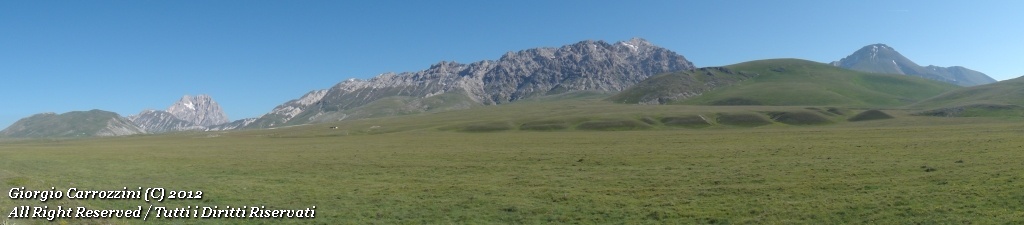
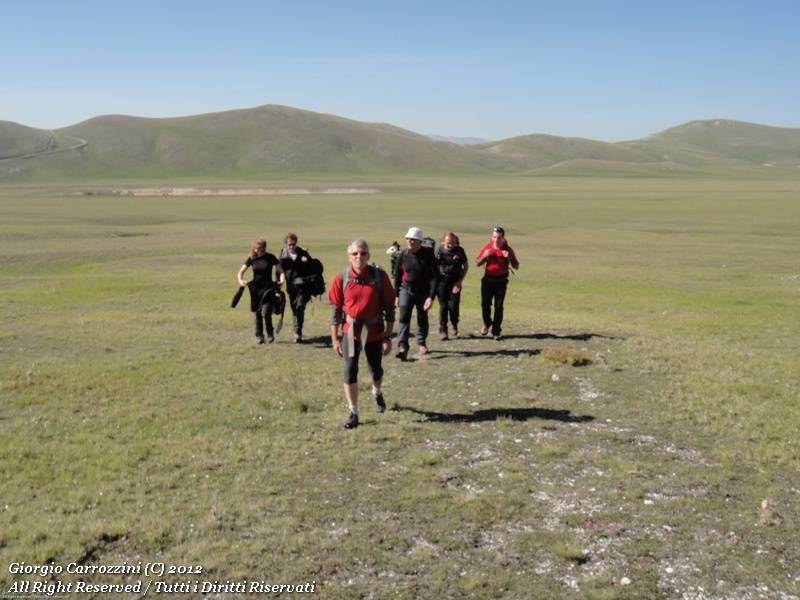
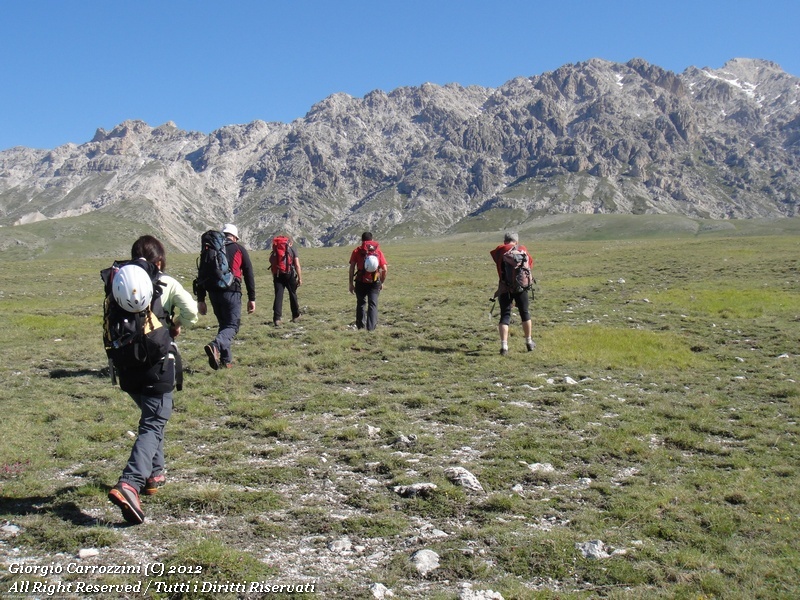
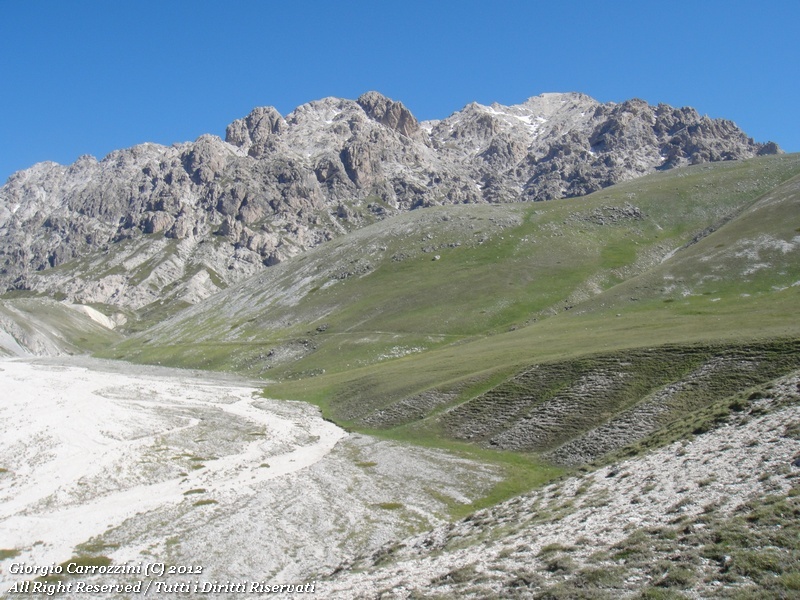
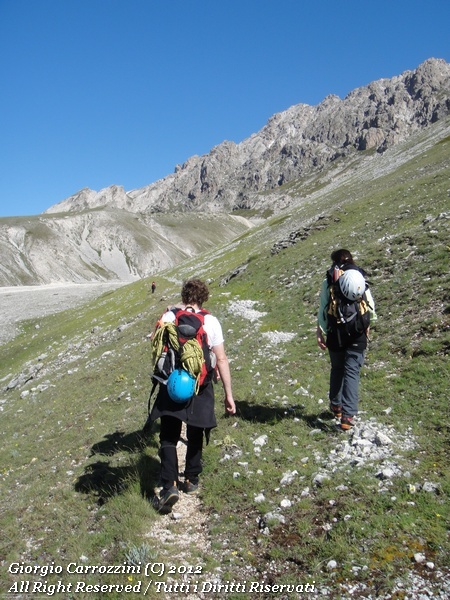
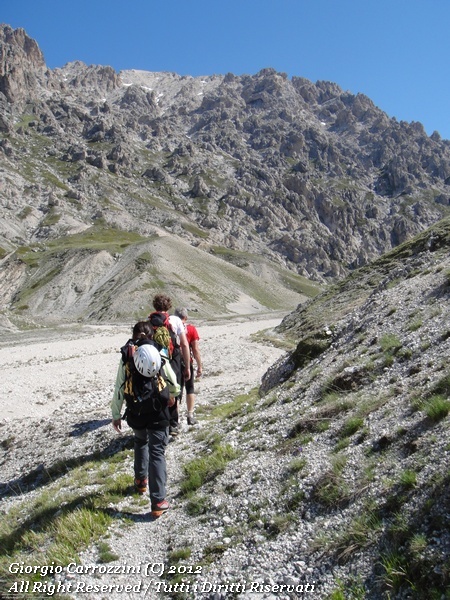
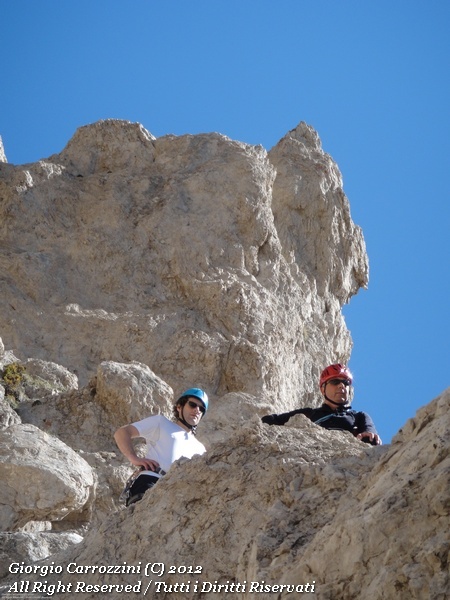
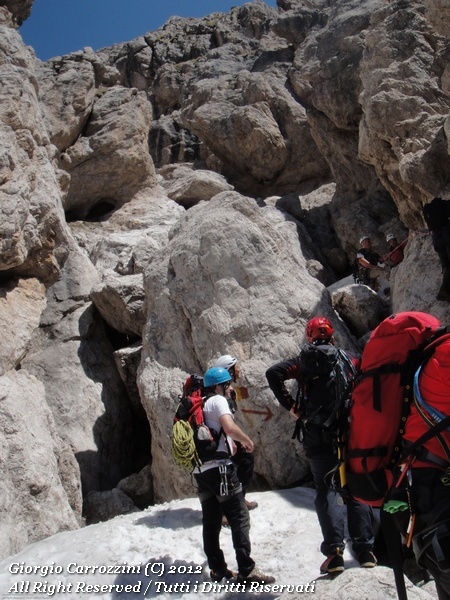
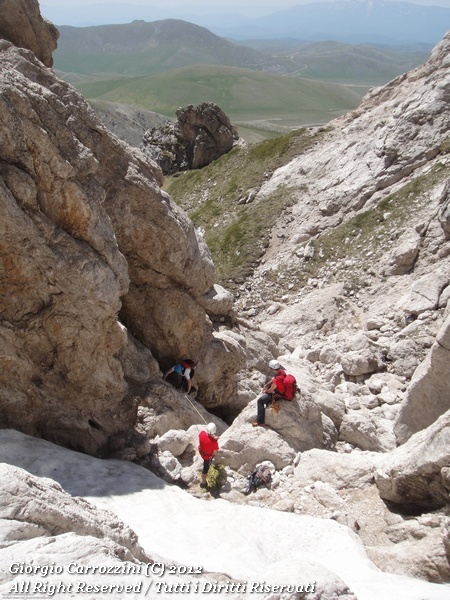
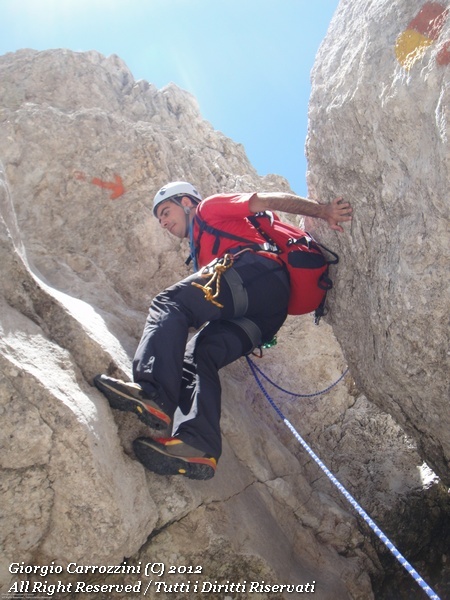
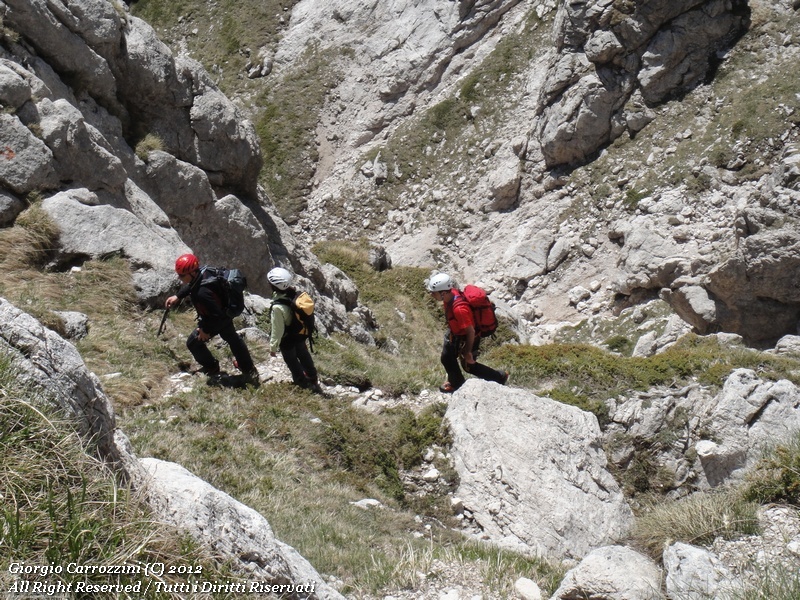
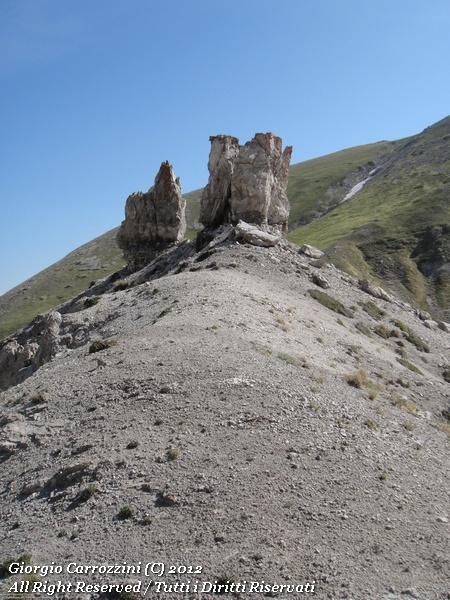
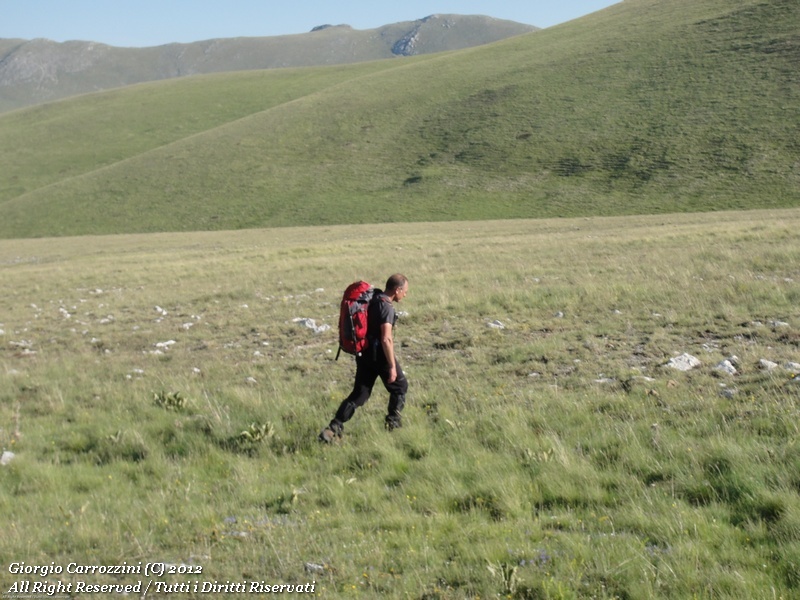
In no time 5 sign up at first, and with Massimo himself plus Fabio and Alessandro (who will join at the last minute) we end up as a wonderful team of 8 enthusiastic hikers. We quickly cross the big meadow below Monte Paradiso, then along the foot of the Veticole. In just forty minutes we are in the gully that will take us to the start of the Via dei Laghetti. The western ridge of the Prena is impressive, completely eroded into hundreds of cracks, little gullies, towers and pinnacles. It is the mountain with the most... ahem... wrinkly side I know. Straight away everyone's climbing instinct is tickled by the little rocks, the slabs, the rocks. We throw ourselves headlong into the climb. The first tricky move puts to the test, first of all, our ability to organise ourselves and to judge difficulties. Nobody wants to be left behind, me included; we pile up on the face, making one mistake after another and putting our own safety at risk. When Massimo realises that it's hard to coordinate the climb from below he takes charge, climbs up and rigs a rope with Michele's help. With the help of the rope we haul ourselves up one after the other in near safety. We pass along a sloping ledge; falling off it you would risk a disastrous pendulum among the rocks. We all get across unharmed. Massimo, the most experienced in the team, calls us to order: “we've done one daft thing after another, let's avoid making a whole heap of mistakes all at once”. His tone isn't angry. Massimo is usually always joking, but when he stops joking it means he is seriously alarmed. On this point I am in complete agreement with him. Here I let myself be guided, because personally I hadn't even noticed the difficulties and the danger. But experience makes the difference. Ever since I started going to the mountains I have always thought that climbing in complete safety and with the utmost caution was the best way to enjoy a great day of mountaineering.
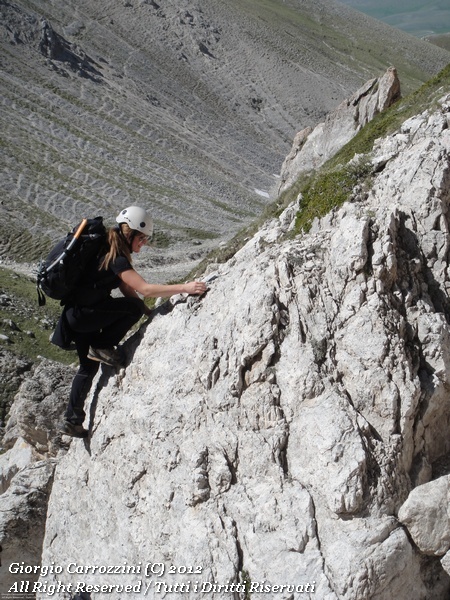
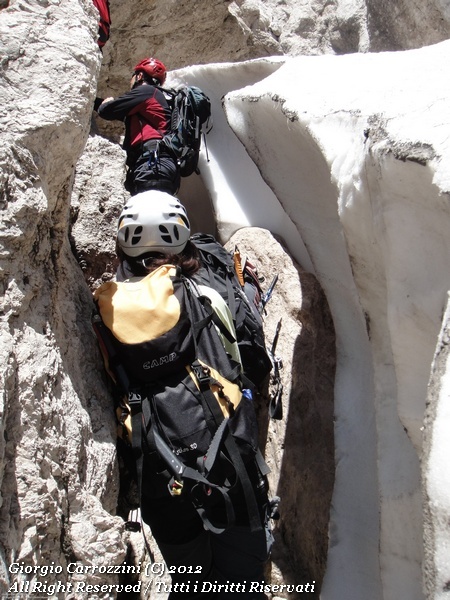
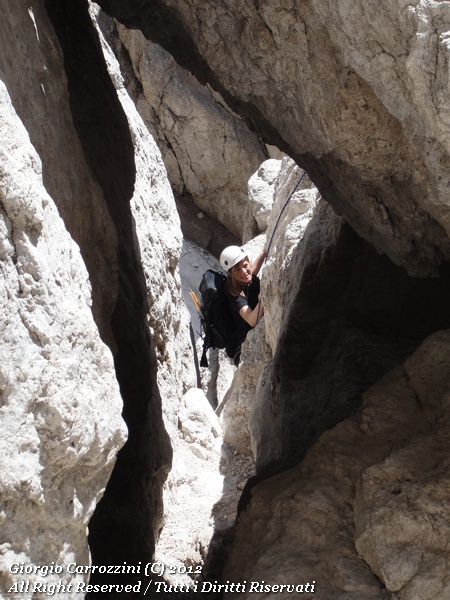
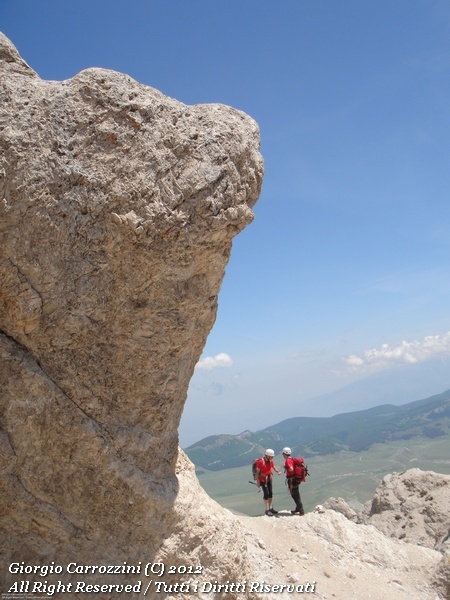
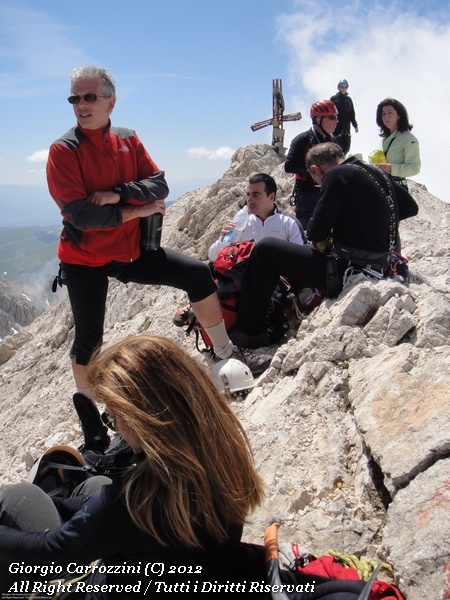
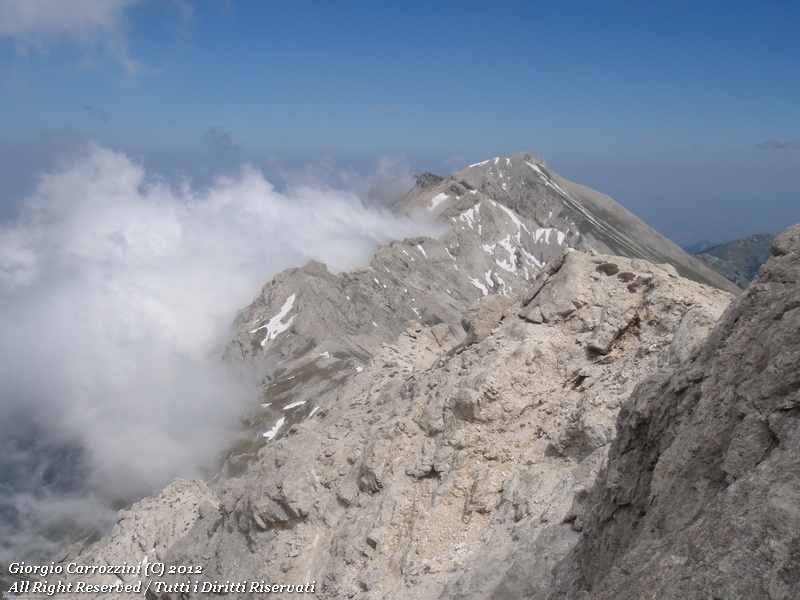
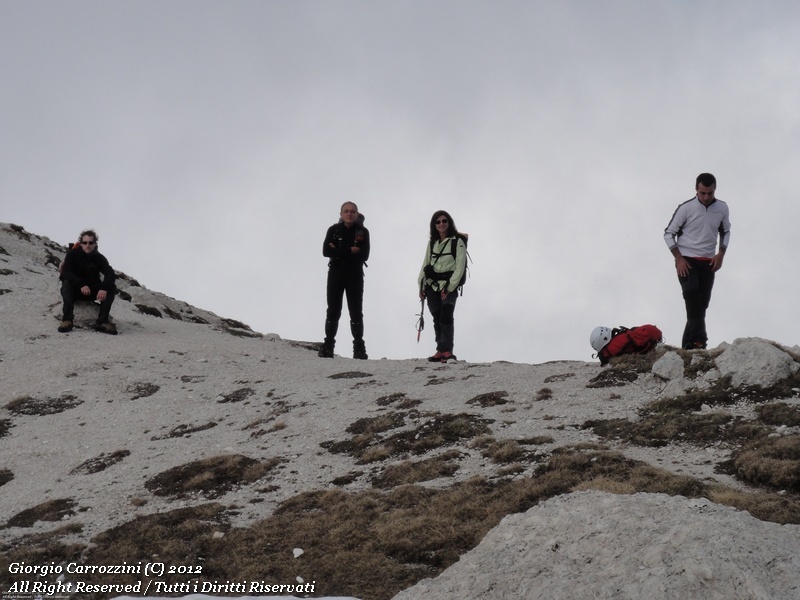
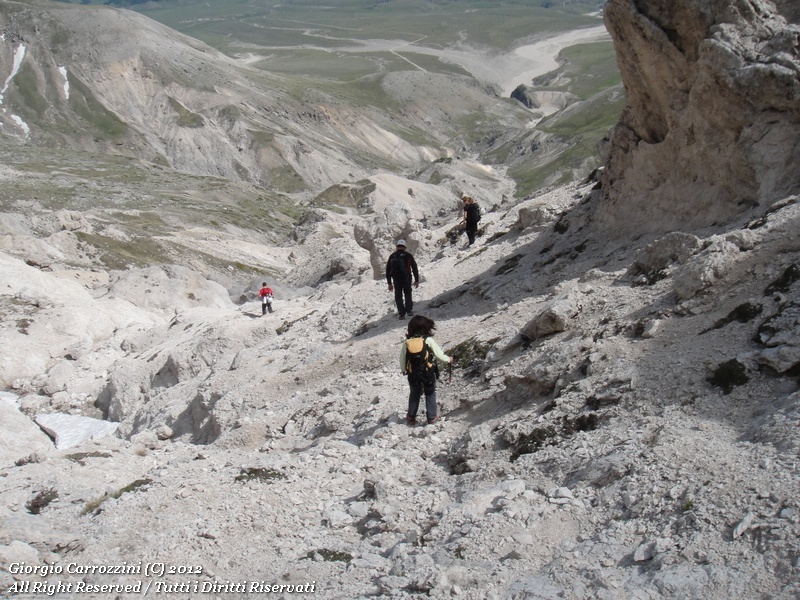
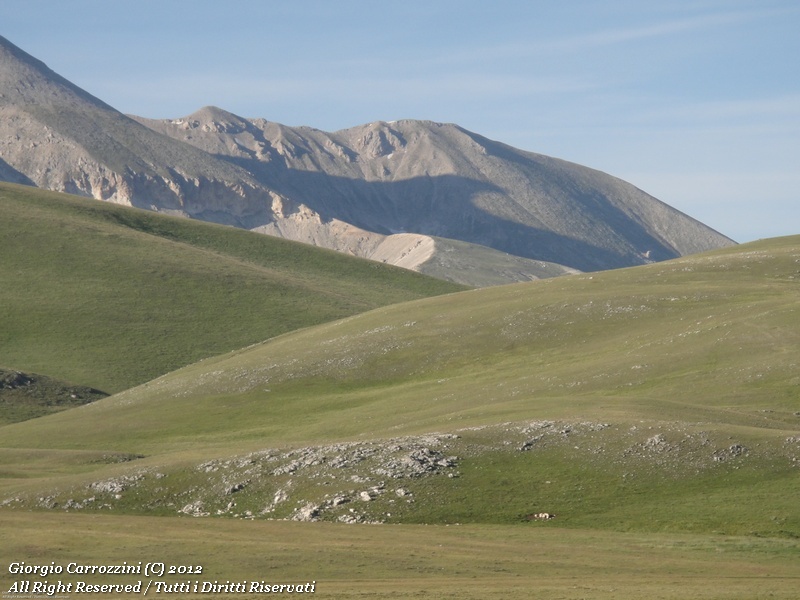
After the first tricky move you climb on traces of path over grassy ledges and fine grit. When the sloping slabs are covered in grit we pay more attention, but we make fairly good progress. The second move that needs belaying is on a rounded boulder that slopes sideways. There is a piton on the boulder. There's a gentleman and two young lads also climbing the Via dei Laghetti. We wait for them to clear the route; Massimo climbs on past and here too he secures the route. One after another we climb up and get past without a hitch. While we climb, Fabio goes on ahead to scout: he is in stunning physical shape and it seems that not even the grade II moves slow him down. The third, more demanding move is a slanting chimney, great fun. Halfway up the chimney you can carry on upwards or pass underneath an enormous boulder. The wait is long: the three hikers of the other group are moving slowly. The girl in their group lets rip with the odd colourful outburst now and then. The outburst is understandable and sets off general hilarity. We spend a few minutes under an ice bridge, then one by one we climb into the chimney. Here too it's Massimo who guarantees everyone's safety, something that any of us, let's be honest, could have done. Out of laziness I didn't even bring the rope, but I am beginning to realise that in certain circumstances you also need to take on responsibility for the safety of others. We get past and come across a snowfield of hard, slippery snow. Out of the rucksacks come the ice axes, which certainly don't replace crampons but at least let us regain our balance quickly. We cross tongues of snow no wider than forty centimetres. It has the taste of real mountaineering adventure. It is. Falling to the right or to the left would mean a drop of several metres into the hollows below. From here the route no longer has any technical mountaineering difficulty. We are at about 2100 metres, give or take a metre. The climb just becomes tiring. The route, which had so far run inside the shady little gullies, now turns into a climb in full sun. The heat, the effort, the thirst slow everyone's pace. Only Fabio doesn't seem to let up. The face becomes rocky and crumbly; we move partly on traces of path, partly on rock. With a steady but decidedly slower pace we climb until we reach the ridge that leads to the summit of the Prena. Here, on a saddle, we meet the ascent route of the Brancadoro. The last 150 metres of climbing to the summit are a massacre for most of us: short of breath, burning calves, no stamina left. I move with exasperating slowness. I take three steps and stop to breathe, another three steps and I breathe... Up above we can now see the summit cross. Fabio, Alessandro, Ilaria and Michele have already arrived. After them come Massimo, me, Daniela and Piero. I feel physically cooked. Straight away I pull out my jacket and cover up against the cold high-altitude wind that freezes the sweat on my skin. I don't even have the strength to eat. I just drink. By popular demand we take the group photo on the summit. Soon the fateful question comes. Which way do we go down? There were two options: back by the Via Normale, or do we go down the Via Brancadoro? We are exhausted, and going down the Brancadoro would need an extra effort of reactivity and attention that some of us don't have. Even I, though I am better trained than the previous times, still haven't reached ideal physical shape. We decide by common agreement to go down by the normal route. The return is long and tiring, like every descent not much fun. But Fabio has become the soul of the day. He has dragged us up and down this mountain with a steadiness and a strength that we all drew on to find the drive to keep going despite the tiredness. As we go down, Piero, who has never had an accident in the mountains, slips on the loose rubble on the slope and tumbles, fortunately without serious consequences. Just a few scratches and a torn pair of trousers are the result of the sudden fall. Daniela and I are on Piero at once; he is bleeding from one hand. We rinse his hand with plenty of water to get the bits of dirt out of the wounds. Nothing serious. As we pull out the first aid kit we realise that Daniela hasn't brought hers and I have brought an incomplete kit. The scissors for cutting the bandages and the disinfectant are missing. The reflection that comes out of it, obviously, is about the need to always check the first aid kit before setting off. Having a complete first aid kit for the whole group would be the most natural thing to do, especially when there are so many of you on a hike, and considering that its "weight" and its "bulk" can if need be shared out among the members of the group. Nothing serious, but... this time too we learnt something... You need strength, caution and an iron will to keep a steady pace. When on the wide meadows of Campo Imperatore I spot the cars, with my cyclonic stride I launch my comeback... I enter a state of pure willpower, the will to close this long day. And as I walk I make my usual reflections on the day. This time too I have learnt something. I think about the fact that training, for anyone who wants to do long hikes or, all the more so, mountaineering, is a necessary if not compulsory condition. When all is said and done, training is necessary for safety, but also so that walking, climbing up and climbing rock don't necessarily have to become a moment in which you ask yourself things like: “but why am I here” or “but what am I doing”... “I'm never coming back here...” Rather, training must manage to let us live calmly with an effort that is always matched to our strength and never beyond it.
It's 19.00 and, even though it's rather late, the beer ritual is a key moment we can't do without. A beer at the Rifugio del Lago Racollo... it's the moment that gathers us round a table, a way of thanking one another for having been there, for having been present, with a taut rope, with an extra word, with the push of willpower...
Route length about 13 km - Height gain/loss: 1090 m |
Photo gallery







Fact sheet
- Hike fact sheet