Today it is no longer the time for books meant only for the mountains. We have reached a higher level of sensitivity. Or perhaps just a different one. What has become important, at least this is how it shows itself, is also the threshold of pain. The summit of pain, rather.
The personal but not solipsistic pain of the one who waits at home for the mountaineer. And who suffers the life in the mountains also because there is no choice but to accept it. Living a love that will never come again also means accepting its destiny. Without being able to rebel. This path was opened by Anne Lauwaert with La via del Drago (The Way of the Dragon).
Buhl's daughter goes public too, today. It's an ugly term that doesn't do it justice. Buhl's daughter tells her own life and her mother's. Hermann's bride, the woman who lived beside him for a few years. Long enough to climb Nanga Parbat in 1953, write one of the absolute masterpieces of mountain literature (È buio sul ghiacciaio, It's Dark on the Glacier), have three daughters and die on Chogolisa in 1957.
A life laid bare. No frills and no prudery. With extreme truthfulness. Buhl's daughter tells us everything she knows. She seems to have held nothing back. She tells us about her father, who was a man but also a lover, and about her mother's jealousy. She tells us how much her mother loved the social whirl, what was left of so many expeditions. How much her father was in love with life without the family. But also how important the family was for a mountaineer like him. Sick with mountains, soaked through with them. How important is the air up on the rock, the summit, for a man like that? It is vital, it let him breathe. He needed to emigrate elsewhere, Buhl, so as to come back.
Saying goodbye is a strange feeling. But it is quite normal inside a couple where the man is a mountaineer to the bone. It is strange that Buhl's daughter manages to distil such subtle and profound reflections despite having had her father for so short a time (she was five when he died).
She manages to understand that a mountain is a mineral fact, without a mountaineer to give it a meaning. It is man who makes it live in a certain way and makes it unique, makes it stand out. Only, to climb certain difficult mountains, impetuous as wild horses, organisation, skill or experience are not enough. Certain mountains need inspiration. This is a simple but absolute concept. It is the most direct route by which the mountaineer is brought close to the artist. Were Claude Barbier, Hermann Buhl, John Harlin or Gary Hemming only mountaineers?
You cannot think of such a limiting reductio ad unum. For a few very simple objective signs: the love of reading, the ability to write well and in an interesting way, a gift for languages, for life. And, above all, an absolute hunger for mountains. Which is a concept beyond the physical. The visceral hunger for mountains has something ancient about it, something unrevealed. It must be an inner brand that only those closest notice. That lets nothing show through and gives you no peace.
Hermann Buhl was a unique mountaineer, brave unto death, in love with life until he lost it in the darkness of the snow.
He loved his wife sensually – his daughter says he had some pepper in him, her father – just as he loved writing. He chains himself to his chair for about six months, and gives birth to a child taller than a mountain, which will be his book. That too is an intimate, solitary labour, lost in the nights when the starry sky stands above man.
Here Buhl's daughter touches another of the most delicate, endless themes of mountaineering. And the strangest, the most inexplicable. Solitude. It is a theme that also comes back in the last book by Walter Bonatti, I miei ricordi (My Memories, Baldini & Castaldi Dalai 2008). Solitude becomes a necessary dimension. A dimension absolutely complementary to the glory that is identified with the absolute ascent. It almost seems that going high cannot do without having faced solitude. But above all without having known how to bear it and overcome it.
Whoever can bear solitude is no longer afraid of anything else. Knowing how to bear it is the real ghost.
When Buhl climbs Nanga Parbat he is a man alone, climbing an eight-thousander without oxygen. Alone. He comes back down scorched by the frost, dazed, burnt by so much solitude.
The leader of the expedition ignores him. If praise can be bought, envy at least has to be earned.
This too is a plague of mountaineering. Envy. A green, grinning mask that takes hold of certain poor in spirit, and through which certain mountaineering affairs are settled perhaps only fifty years later.
Buhl will become a national hero. He will always feel a ghost inside himself. A grey creature, halfway between the demonic and the angelic, a breath both burning and icy at once. He will feel it caressing his amputated toes every time the mountain calls him back to itself.
After four years of lectures, and it is lovely to know that his wife used to drive him by car at night to his engagements, Buhl dies. Inside the car those two, mum and dad, lived their life as a couple. The most knotted part of it, the most sentimental and shared. Outside the darkness, and inside two souls divided between a summit and a presentation.
When Hermann dies, the daughters are small. His wife has to roll up her sleeves and begin a new life. That of a widow, still attractive, with three small daughters.
At this turning point, the book too shifts to another register. That of life as lived. The attention moves to the life of a woman alone and to her difficulties. Feelings become this woman's invincible weapon. And the mother's soul becomes the finest subject of the book. Perhaps there is no stronger, more gripping description than that of the grandmother's death as lived by the writer's mother. It is a deadly description, raw, with no pretence and no padded partitions.
Seeing your mother die is an absolute pain, one that never forgives again. A stab in the heart, a fistful of pure death. A descent into hell in a few seconds. And then a wide, still sea of dark pain, a deafness you never get up from. A never-ending Golgotha.
This threshold becomes a key to understanding a new dimension of mountain books. The literature on the subject has changed. It is bound to become more refined, a subtler breath. Higher than the mountains there is the wind. Higher than the wind there is always the heart.
This is the meaning of inspiration. But it is also the meaning of life. Existence is never a calm sea. It is what happens to us while we are making other plans, as John Lennon said.
Buhl lived only a few years. He concentrated a tremendous energy in his affections, in his ambition to run away so as to know how to come back better.
Today children, partners and wives have to tell us who mountaineers are. The time of the picture postcard is over. The age of life inside the page has begun too. We have to look closely at the gods of the mountains. Dig into their damned clockwork mechanisms. To do it, though, you need feeling, delicacy and inspiration. As you see, nothing more and nothing less.
The result may not be guaranteed, though. Here, the heart has done a lot. The rest was done by a fine hand devoted to writing, and by a blood that inevitably tastes of the mountains, just as water goes to the sea.
Yet we cannot forget that books like this are born of pain. And of all that sense of loss that writing has somehow tried to exorcise.
Fact sheet
- Title
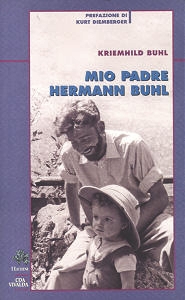
- Mio padre Hermann Buhl (My Father Hermann Buhl)
- Author
- Kriemhild Buhl
- Publisher
- CDA & Vivalda Editori
- ISBN
- 9788874801329
- Pages
- 236
- Photos and illustrations
- Black and white
- Year first published
- 2009
- Price (euros)
- 23.00