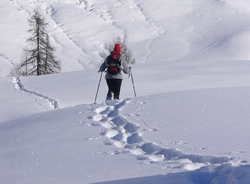
 The mountains: a choice of life and of passion…
Hi Paolo... Tell us about yourself...
I'm the son of a mountain lover: when I was small she used to take me to Filettino. Curiously, my strongest memory is the boredom and the nuisance of "having to walk" up and down the woods of Campo Staffi, the Viglio and so on. When you're a child it's hard to find motivation! The "catharsis" came at the end of my first year of middle school. Roncadizza, near Ortisei, right in Val Gardena; at the time (1977) the village was a few chalets, a church and a presbytery where we slept. The rest was all flowering meadow and trees and animals. I've always avoided going back, imagining the havoc caused by the tourist exploitation that came afterwards. Only a few years ago I drove through it and it was like watching a dream vanish. It's from then that my love for the mountains was born; I then became a cub scout, walking up and down the Casentino forests, the Abruzzo National Park and many other beautiful places. Then for many long years I stopped going, for various reasons: the first is my other great passion, which taught me so much, athletics, practised competitively, albeit with poor results; then a girlfriend who didn't walk, and then the usual problems, no company, no money and above all a certain ignorance. It's incredible, in fact, how little we know, especially full-blooded city dwellers like me, about geography and landscape, above all those closest to us. Who would have imagined that near Rome there could be dozens of paths waiting to be discovered and walked? But the desire was always there, and so, once I'd got my degree, started working and given up athletics, I went back. At first with groups and associations in Rome, then organising things on my own. And so I went round the Dolomites, Piedmont, Abruzzo, the Valle d'Aosta, until I reached Lombardy, where I stopped and became an Accompagnatore di Media Montagna (qualified mountain leader).
Rosy Cappelli (La Repubblica) says that people who go to the mountains are a bit like alchemists, because they put so many things together...
I don't know Rosy, and so I don't know what her experience of the mountains has been. But I want to make one thing clear straight away: the mountains are not in themselves, objectively, an "elevated" world, neither spiritually nor in any other respect, nor do they hand out certificates of moral nobility to those who go there. The mountains are a world where some people find and feel emotions, reflections, sensations that others may find in other settings, the sea, music, poetry, etc.; some even feel negative feelings, fear, claustrophobia. The mountains are what we want them to be, and for me, over the years, they have been a companion and a friend who taught me simplicity, effort (together with athletics), my own measure. Despite the job I do, which I'll come back to later, I have been, and in part still am today, basically a loner. For contingent reasons, for many years I went to the mountains alone and I learned to listen to myself, my fears, my moments of happiness, to alternate rationality (the weather changing, the attention you have to pay on a via ferrata or an exposed path, etc.) and abandoning myself to the thrill of the moment, to discover that "safety" mainly means knowledge of, and symbiosis with, the environment.
Sorry Paolo, I hate these journalist's questions too... but tell me... of the activities you can do in the mountains, which do you prefer... I don't know, ski mountaineering, mountaineering, trekking...
 ...mmm... I'll start from the observation that a real definition of the different activities doesn't exist, so I'll add that I'd name trekking as my favourite activity, where by trekking I mean a journey on foot, mostly itinerant, as self-sufficient as possible (food, water, spare clothes, maybe a tent, everything in the rucksack), whatever kind of ground it takes place on, except for climbing above grade II/III and skiing, for the simple reason that I can't ski and I'm not a climber, so on more complicated ground I wouldn't be able to move!
Also... as I said above, I started out as a loner and the mountains were essentially an escape from the city and from work, a moment of physical effort where the aim was to reach a balance, a peace, between me and the environment, without really knowing it, in short an entirely inward moment. Then with a few friends I shared the experience of mountaineering, a new dimension; the communion that comes from being roped together, dependent on and master of your own life and someone else's at the same moment, is the strongest thing there can be. Dangers, decisions, joys that come together and merge. And then the mountain leader course. It was discovering a new way of going to the mountains: flowers, trees, rocks, landscapes, the signs of man little by little took on names, reasons, roles, meaning. It was a real turning upside down of going to the mountains. Walking to learn, to observe, to discover. And finally the job of guide. So many people led along paths more or less everywhere. So many human relationships, so many ideas, so many lives lived, so many details were created and changed, walking together. But the beauty of being a guide is in the thanks, explicit or implicit, you get from the participants: "I was just thinking that of 14 treks not one was bad, while many were wonderful"! (from an e-mail I received from a friend). This is exactly where the beauty of the guide's job lies, and the difference between those who work as guides and those who simply accompany a group of people: the latter think of the group as an opportunity to do something they like (a journey, a trek, a hike), the former are aware they are doing something for others, to give them the greatest satisfaction from the experience.
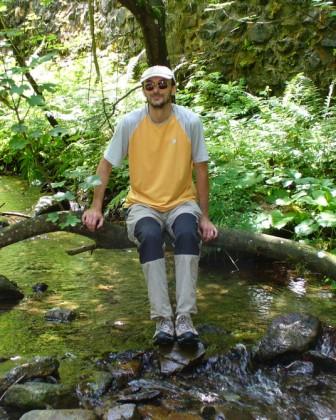 On your website (Sentierando) I saw you've been on the Gran Sasso... What do you think of the Apennines? The mountains, the running of the parks, the restrictions, the mediocre management of the huts...???
The question is loaded, because it invites a negative answer. But unfortunately you're absolutely right. The Apennines, first of all as a landscape, are snubbed: in the north they are considered second-rate mountains, in the centre-south at best a training ground for the Alps. And it's a shame, because those who come to the mountains not for their mountaineering and sporting side find, precisely in the Apennines, that cultural dimension which is missing on the high peaks. Pastures, woods, historic villages and then the isolation due to the enormous depopulation of the last 50 years make the Apennines a place well worth rediscovering. Obviously, to rediscover you have to protect, maintain and publicise. In the Apennines (but this goes for the Alps too) the state of the paths, the maps and the overnight stops is tragicomic; at times the very concept of hiking seems to be missing. You ask me about the Gran Sasso, but by Apennine standards that's almost a happy oasis! Thinking back to memories from many years ago, so of places and situations that today may be, I hope, very different, I think for example of Coppo dell'Orso from the Val Roveto, completely devoid of everything! climbed by a trace that was waymarked at first and then got lost, and wanting to do a loop I found myself going down the bed of a dried-up stream between rock steps and a tangle of trees, and we're talking about an area right next to the Abruzzo National Park!
You see Paolo,... I think that people who go to the mountains have something special inside, a magic, a sort of third eye, that lets them look at life with a very particular wisdom... If you could give people a message, a message about the world of the mountains, its peoples, its animals, its nature... what message would you bring?
Too often, especially we city dwellers, we forget that the mountains were first of all an environment where man adapted to live, one of many and certainly not the easiest or most comfortable. The aesthetic change that made the mountains an ascetic symbol, of purification(!), of moral elevation, happened only recently, with the coming of Romanticism, which "invented" mountaineering, making it not a useless and dangerous activity but a means of inner progress.
It's important to remember this because for many "mountain folk" the mountains are still a synonym of toil, of a living scraped together with your fingernails, and so many "mountain folk" can't conceive of going to the mountains just for the sake of it, and even less of a tourism and an economy based on "tourism that walks", with plenty of obvious damage, unfortunately. And it's important for debunking the epic of going to the mountains or, if you prefer, of the struggle with the mountain. I don't believe that people who go to the mountains have "something inside". The person who goes to the mountains is the same person who goes to the office, to their family, out into the world; if they have something inside they always have it, otherwise...amen!. The mountains, with their extremes, lay bare everyone's essence, that yes. And in the mountains, while you're toiling, when you feel, more or less really, in danger, when a problem crops up (a person to rescue, a rucksack to carry, food, water, clothing to share), when you need to show solidarity and patience, that's where you see people's nature. The only message I'd feel like giving is to take a step back. It isn't necessary, indeed it's absurd, to think and expect that everyone should go everywhere; each of us has psychological, physical, technical, cultural limits. Each of us should try to know them and do what those limits allow. A walk in the woods is more rewarding than reaching the top of the Marmolada by cable car. I realise that this reasoning sets off an "infinite regress", but I believe we've gone too far in the opposite direction not to start discussing situations that are objectively absurd (just two, by way of example: the hundreds of people crowding the glaciers of Monte Rosa, or the project to build a tower on the Piccolo Cervino, making it reach 4000 metres so as to take tourists up there).