All the information you will find on this page is for information only and not for teaching. For those who are not experts we suggest contacting an Alpine Club, a Sport Climbing Club, a professional Mountain Guide or any school qualified to teach mountaineering and climbing. Clearly, you use this information entirely at your own risk.
How do you choose a rope for sport climbing?
For most crags, especially for a beginner, it is enough to buy a single rope 60-70 metres long with a diameter of 10mm. This is certainly the standard for anyone starting to climb on bolted crags. A rope of this kind can weigh quite a few kilos; to carry it you need a roomy, sturdy rucksack.
It would be very different if you needed a rope for climbing on high-altitude faces. In that case the things to consider would be very different.
If you want to cut down the weight in your rucksack, when reaching the crag means walking a few kilometres, you can choose a 9.7-9.8 mm rope.
When you set out to buy climbing gear it is certainly better to spend more to make sure you buy new products (never used or second-hand). In particular, the rope must come with its certificates of guarantee. It is important that at the time of purchase the rope is marked at the ends with taping that identifies the type of certificates of guarantee: UIAA certificates and European (CE) certificates.
Care and lifespan of the climbing rope.
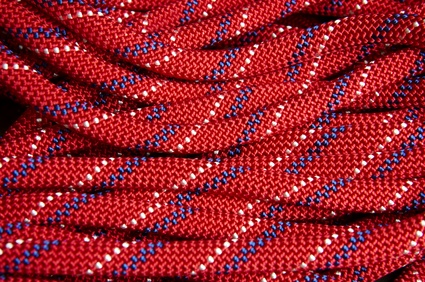
It should be noted that in sport climbing all the gear and products we are going to use to climb are fundamental: they must always be in excellent condition, clean but above all intact, and never damaged.
First of all, the rope should always be kept in a clean, soft nylon bag bought specially for the purpose. On the market there are bags fitted with a square sheet. Opened out and spread on the ground to its full size, this sheet lets you uncoil the rope without getting it dirty with earth, sand or grit.
A rope, even a new one, has to travel to the shops where it will be sold. It is packed, folded to take up little space, carried through numerous warehouses. As you can guess, the rope starts ageing as early as the factory. It is put in piles of materials, kept in cardboard boxes, then displayed in shop windows. Exposure to sunlight alone, and so to UV rays, can alter its physical characteristics.
Bear in mind that a rope has a lifespan beyond which its use is not recommended.
The average wear time of a rope varies with the kind of use it gets.
- For mountain professionals who use it every day, a rope is usually reckoned to last between 3 and 6 months, depending also on the number of falls taken on the face.
- For use limited to the weekend, the climber can expect it to last from 2 to 3 years.
- Finally, for occasional use the rope, if well kept, can last as long as 5 or 6 years.
Beyond this limit its use is always discouraged.
Finally, the rope we will trust with the job of holding our fall must show no signs of damage, must not be frayed or, in some cases, flattened. The outer part of the rope (called the sheath) must not be damaged. Along its whole length the rope must keep a round cross-section so that it runs properly through the belay devices (Sum, Gri-gri, figure-of-eight, plates or tubes). A rope that has been squashed for a long time because it was badly coiled can have an oval cross-section. In this sense looking after the rope is particularly important. Once back home you need to take it out of the rucksack and coil it properly or lay it out in a dry place, avoiding keeping it compressed or folded too tightly.
Remember, of course, that the rope must be cleaned, always with a cotton cloth lightly dampened with cold water, to remove any residue of dust and grit stuck in the outer fibre. You can use a soft synthetic-fibre brush during washing. In any case, always remember to dry the rope with a towel; never put the rope in the sun or near sources of heat such as radiators or hairdryers to dry it. Remove the excess water and leave it to dry indoors, in a place that is not damp.
- have a damaged sheath (outer cover);
- when checked hand over hand, show a damaged core (inner part);
- have had to hold a fall with a fall factor close to 2;
- have been stored in contact with chemicals that could cause the nylon to melt, corrode or change chemically.
Frequently asked questions
How long does a climbing rope last?
It depends on use: for professionals who use it every day it lasts between 3 and 6 months, for those who climb at the weekend 2-3 years, and with occasional use and good storage as long as 5 or 6 years. Beyond these limits its use is not recommended.
What rope do you need to start climbing at the crag?
For most crags a beginner needs just a single 60-70 metre rope with a diameter of 10 mm. If the approach is long and you want to lighten your rucksack you can choose a 9.7-9.8 mm rope, always new and UIAA and CE certified.