The gentian family (Gentianaceae) includes about seven hundred different species distributed in about seventy distinct genera, of which the most important representative is the genus Gentiana.
They are a group of annual, biennial or perennial plants.
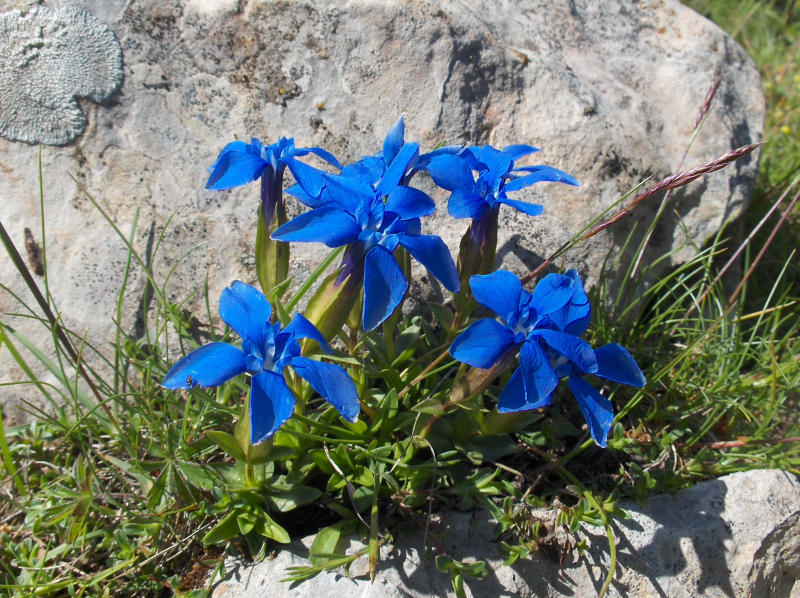
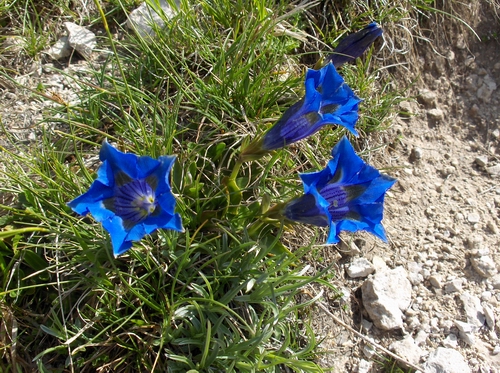
Having to face the mountain climate, with low temperatures for much of the year, they take a very long time to reach maturity. They have thick, fleshy, cylindrical roots and contain bitter glucosides. They often have no stem or develop short creeping stems. These stems bear flowers of deep blue, red, pink or yellow. The 4-5-lobed flowers can be grouped in inflorescences or bloom singly. We find plants of the genus Gentiana in the temperate regions of Asia, Europe and the Americas. They prefer an alpine-type habitat; we find them at altitudes going beyond 2500 metres. They live on limestone soils, moist but well drained. In particular they find their ideal environment in high pastures, where they reproduce by seed in spring. In Italy they are present in the Apennine and Alpine regions.
 In the genus Gentiana the best-represented species is Gentiana lutea L., improperly called the great gentian (genziana maggiore). This perennial species has thick, fleshy roots and simple, erect stems that can reach 40 – 150 cm. The leaves are opposite, ovate-lanceolate, with 5 parallel, prominent veins. The flowers are yellow with brown speckles and grouped in inflorescences at the tip of the stems and in the axils of the upper leaves.
When identifying Gentiana lutea you must be careful not to confuse it with Veratrum album L. (white veratrum, or white hellebore), which is poisonous. Without flowers the two plants are very similar, but the veratrum has alternate rather than opposite leaves, slightly downy on the underside.
The interest in the great gentian, as in some others belonging to the same genus, lies in the fact that gentian is widely used for the production of liqueurs: grappa, brandies, distillates for aperitifs and bitter digestifs. The healing properties of the roots, which contain extremely bitter and aromatic principles, were already known in antiquity for their stimulating, tonic and antipyretic action. Its decoction was used until recent times as a vermifuge.
 The botanist Pierre Lieutaghi recalls: “Since the plant grows very slowly and is very often uprooted before it flowers, it ends up disappearing from its natural habitat”.
For this reason, since the seventies, a large number of regional laws have been adopted in Italy to protect, in mountain areas, all the species of the genus Gentiana present in Italy.
Many aperitifs on the market today are made from Gentiana lutea. In the mountains, as an aperitif, people prefer a slightly bitter brandy to stimulate the appetite. To make brandies by traditional methods the fresh roots (rich in sugars) are left to ferment in a bundle. From these, by distillation, you then get a brandy that puts the best of our home-grown spirits to shame.
To gather gentian for production, the producers usually apply for the appropriate regional authorisations. Gathering is mainly done after the summer, between August and September, taking care to gather mature plants so as to safeguard the reproduction of such a fragile species.
The regions most involved in this kind of tradition, and which have adopted clear rules for the production of gentian grappas and distillates, are those of northern Italy, namely Alto Adige, Trentino and Piedmont, and much has also been done for its protection in Tuscany.
Bibliographical notes:
Guida Botanica d'Italia – Eugenio Baroni – Ed. Cappelli
Fiori di Montagna – Maria Teresa Della Beffa – DeAgostini
More pictures of these flowers in the gallery Mountain gentians.