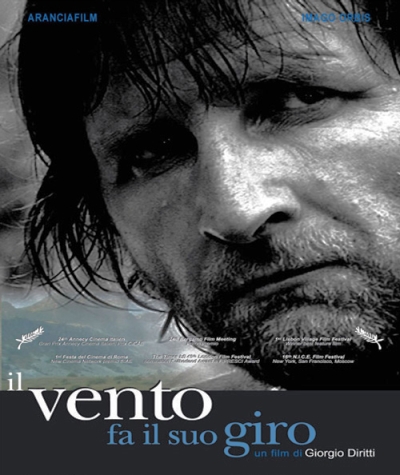
 If a film manages to have the sweeping force of a book. Usually the opposite happens. A film is made from a book, almost as if it were a natural, organic rib taken from it. A natural extension.
This is a hypnotic film. About mountains and about other things. About betrayal, violence, spite, envy, and a beauty that takes your breath away like an orgasm. It is set in Chersogno, a tiny handful of houses and eyes, animals and flowers in the Occitan Alps. Philippe arrives with his family and his cheeses. At first they welcome him with torches lit in the evening, and your eye seems to meet a living nativity scene. Then they begin to hate him and the village splits in two like an apple. Two factions and two worlds. There is a strange feeling in this film, which they started distributing on DVD this year. It is shot with non-professional actors, that is, all local people, apart from the lead and perhaps one or two others. It is the perception that life, whichever way you turn it, is like a knucklebone. It never lands where you would like.
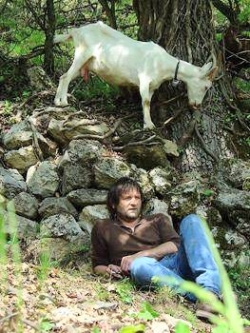
Philippe is a shepherd with a beautiful wife and three small children. He doesn't take holidays, he makes cheese. And he is looking for a place where nature is not yet infected, or is still a place in the sun, well lit. Philippe is looking for a world where flocks can graze without problems. He is looking for an Indian reservation. He seems to find it. That tiny village seems to open up out of a physical difficulty in communicating. It is like watching a stone break slowly, almost crumble. Its inhabitants overcome with difficulty a mistrust made of stones and centuries. It is a mistrust that comes from the mountains, from the wary journeys made along the salt roads, with an eye alert to spot danger in the fog or behind the pass.
The world of Chersogno is beautiful photographically, or for going to spend your summer holidays there. If you live there but are not from the place, it can become a nest of deadly vipers.
In the film life is played out in full. All the seasons are made to roll by. So too the images, always caught with an extremely sensitive eye that captures the most delicate moments of the day, give a panorama of the Occitan Alps. A world almost tinted blue by the sun when the days are clear, where the eye runs on without finding any limit to the sky, any closure to girdle the gaze and hem it in.
The painful part – but it is the truest part – begins at the moment when real life, the life bound to the closed, obtuse and snub-nosed mentality of the inhabitants, breaks loose like nature. Without limits and without rules. Wild, yet reasoning in its desire to expel a foreign body from its own belly.
 The envy closes in. From anonymous letters to voices whispered over and over. The hardest blow, the three-hundred-crown one, is dealt to Philippe by the person closest to him, his beautiful, sensual wife. Who has something whorish about her already in the way she moves, but whom you don't suspect at first, with those three children that seem like a coat of mail against infidelity. And even that betrayal, in such a forced and violent setting, becomes confirmation that the waters have broken. And when they start to move, you cannot imagine they have a reason ruling over them, telling them to control themselves, come on, ladies and gentlemen, one at a time. No, misfortune has no rational borders, it has no Cartesian fences around it. It is, instead, the night-time dance of madness, and of love when it splits your heart.
The scene of the Occitan dance, during the summer festival, is a lusty moment of the strongest sensuality, of unheard-of human force. It is a subtle bacchanal that turns into the awareness of betrayal committed by the one closest to you, and you don't know what to do.
One look from Philippe as he sees his wife astride her lover's shoulders, running through the narrow, stony lanes of the village, is worth a whole treatise on psychology. And it amounts to a sort of film within the film, almost as if to let the viewer understand that something is not right there. That there is something murky between husband and wife too.
Perhaps the betrayal was not needed, partly because it has no logical cinematic or narrative justification. But can betrayal be explained? In life, can it be given a rational justification?
I am reminded of The Short Happy Life of Francis Macomber, where a wife is a whore because of the sloth and cowardice of a husband who puts up with it and cannot free himself. When he does, thanks to a dose of courage that life suddenly offers him, almost an unhoped-for gift, Macomber dies.
Here nobody dies, or rather, there is one who dies. And so a whole life fits into one film, and a hundred stories twisted, no, tangled together like in one of those patchwork blankets people used to cover themselves with on those very mountains.
It takes a skilled eye to capture those mountains so well. To make such clear and faithful portraits of them. It takes someone with an absolutely original idea to invent a story like this.
The film is in the original language, that is, in Occitan, so you will need the subtitles to find your way better through the dialogue. Even though there is a common thread thanks to which the film never leaves the viewer without an inner gasp. Fredo Valla has written a mountain story, but above all a story of a humanity he ought to have concentrated in the pages of a book. So it is not just a film. It is rather a film where the strength of the characters and the people is earth to take in your hands. It is a wind where the passions are heart, lungs, brain and sperm. It is life that comes full circle and always returns to where it was before. It is a life where the wind always does what it wants. And we stand beneath it. When man makes plans, God smiles.
This is His film.
Additional information about the film
Title: Il vento fa il suo giro
Director: Giorgio Diritti
Story: Fredo Valla
Country: Italy
Year of release: 2005
Colour, 110 minutes
Notes: Written by Giorgio Diritti and Fredo Valla from a story by Fredo Valla.
The screenwriter Fredo Valla, who wrote the film with Diritti, is also mentioned in Fratelli di roccia e solitudine.