The Apennine chamois (Rupicapra pyrenaica Bonaparte, 1845, subspecies ornata)
The chamois is a ruminant mammal of the Bovidae family; this species is found in the mountain areas of south-western Europe (Italy, France, Spain).
There are three main subspecies of particular naturalistic interest:
- Rupicapra pyrenaica ornata; (central Apennines)
- Rupicapra pyrenaica pyrenaica; (Pyrenees)
- Rupicapra pyrenaica parva; (Cantabrian Mountains)
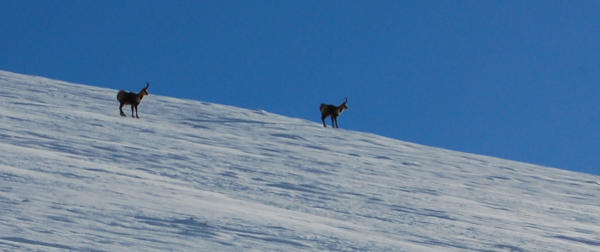
Of these three subspecies the most protected is Rupicapra pyrenaica ornata, the subspecies known as the “Apennine chamois”. The protection of this rare mountain animal is justified by the fact that from the end of the Second World War until the seventies there were no more than 300 individuals along the whole Apennine chain.
DISTRIBUTION
The founding of the Abruzzo National Park made a considerable contribution to repopulating the mountain areas. In fact, from a group of individuals that survived on the  Majella, and thanks to a reintroduction project (signed by WWF and PNALM) for this rare subspecies, the Apennine chamois has reappeared on the mountains of the Abruzzo National Park, on the Mainarde, and right up to the ridges of the eastern chain of the Gran Sasso (see photographs: Monte Camicia 01-10-2006).
Compared with the subspecies living in the Pyrenees, the present Apennine population is very small: we are probably talking about a census that does not exceed 600-700 animals (2004 census), but it shows just how much protection and action on the ground can increase the populations of animals at risk of extinction.
MORPHOLOGY
It is a small animal, no more than 100-120 cm long, whose height does not exceed 70-80 cm. There are no particular differences between males and females; the main distinguishing features are:
- males are generally a little larger than females; the male's horns are longer and their deeply hooked tips turn further inwards;
- behind the ears the male has large glands secreting a strongly scented serous mucus, which he uses during the rut;
- the belly is more convex than the female's;
- the tuft of hair near the penis (the so-called “brush”);
In both sexes the winter coat is darker than the summer one, which is generally light brown.
BEHAVIOUR
 Chamois live and gather mainly in groups of females and kids; adult males, on the other hand, live alone and join the females only during the mating season, which usually takes place in autumn. Gestation lasts about 24 weeks, that is until late spring. In May-June the females withdraw to give birth to the young chamois, which within a few hours are already able to walk easily. Young males leave the herd to lead a solitary life from as early as two years old, a solitude that lasts until sexual maturity, which comes at about eight years of age. Females stay all their lives in the herd where they were born.
The chamois prefers a diet of grasses, which is why we find it on grassy slopes and high-altitude meadows. When grass is scarce, as in winter, it also feeds on shrubs.
It is an animal that thrives in the wild and is very elusive in its behaviour. Its natural predators are wolves, which are repopulating the whole of the Apennines, to a very small extent the Marsican bear (for those few individuals that remain), the lynx and the golden eagle. It must be stressed, however, that the real threat to the Apennine chamois is hunting, poaching inside the parks and, unfortunately, ever more intense tourism inside areas set aside as nature parks.