Hiking, and even more so mountaineering, are activities with a certain degree of risk.
By tripping on a stone, losing your balance on rough ground or falling off a face you can suffer injuries of every kind, from the most trivial grazes to the most extreme consequences.
Although the advice is to be as careful as you possibly can, keeping situations under control doesn't always manage to prevent the unforeseeable. Still, being ready for anything, being able to judge how serious an accident is and knowing how to step in with the right means can save the lives of our companions and our own. This is one of the reasons why we always suggest not going into the mountains alone.
Besides, we cannot ignore the subject as if we were immune to danger, or simply by underestimating the dangers we face.
At the moment of the accident the first rule is to keep a cool head, avoiding rushing headlong to help the injured person. It is always better to move with the utmost caution, so as not to make the situation worse with further accidents.
Once you have reached the injured person you will need to make a first assessment of their condition.
The first thing you can do after reaching the injured person is to check the injured person's state of consciousness.
If the injured person is not conscious, check immediately whether they are breathing normally: look at the chest, listen and feel for air from the mouth for no more than 10 seconds. Observe whether they are breathing on their own, with difficulty or not at all. If they have difficulty breathing, check whether there is blood or other matter such as vomit or gastric reflux in the airway blocking the passage of air.
There is no need to look for a pulse: for anyone who isn't a health professional it is an unreliable check and it wastes precious time.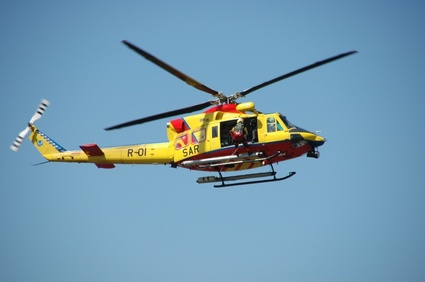 If the injured person does not respond and is not breathing normally (even just slow, noisy breaths, so-called gasping), they must be treated as being in cardiac arrest. Call 112 straight away (or have a companion do it), putting the phone on speaker and explaining that it is a patient whose life is in danger: in the mountains a mobile phone picks up a signal more easily on ridges and summits. Then immediately start cardiopulmonary resuscitation: one hand on top of the other in the centre of the chest, arms straight, press down 5-6 cm at a rate of 100-120 compressions a minute, letting the chest come all the way back up after each compression. Those who are trained alternate 30 compressions with 2 rescue breaths; those who are not, or don't feel up to it, give compressions only, without interruption. If there are two of you, swap over every 2 minutes or so, so as not to lose effectiveness. If a defibrillator (AED) is available, switch it on and follow the voice instructions. Do not stop resuscitation until help arrives or until the injured person starts breathing normally again.
If instead the injured person is conscious and shows signs of being awake, you will need to check whether they can answer simple questions, whether they can remember and whether they respond to pain stimuli.
If the patient's state of consciousness is good, then examine the condition of the limbs and the spine. Assess whether the injured person can move their limbs on their own, and whether they have feeling in their arms and legs.
After observing the patient's general condition you will need to lay them down comfortably so as to be able to look after them properly, cover them with your own jackets to prevent hypothermia, which is made more likely by blood loss, and, only if they are fully conscious and have no serious injuries, give them small sips to drink. Immobilise the injured joint and bone, even using sticks or the ice axe as supports. Raise the injured limb: this will slow down its bleeding and the growth of tissue swelling.
At this point you will need to assess the type of injury the patient has, whether it is a bruise, a sprain, a dislocation or a fracture.