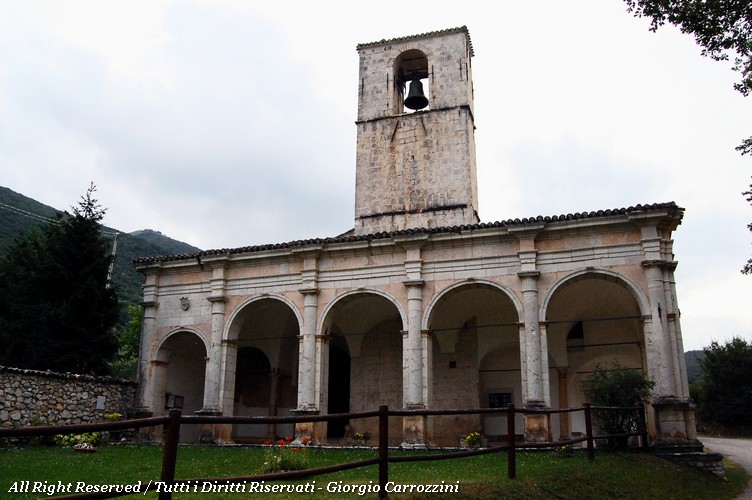
The church of the Madonna Bianca is a large country building a short distance from the village of S.Angelo di Ancarano, dating from the 14th century, built shortly after the destruction of Castel Franco, originally perhaps with a single nave and later doubled, like other churches in the area.
The church is built of white stone and its front is adorned with a Renaissance portico, with a Lateran coat of arms above the first arch on the left; on the right-hand side, on the other hand, there is an older portico.
The rich 15th-century stone portal is perhaps the only survivor, since where another one should have opened the mighty bell tower was raised, with a single opening for a large bell and a characteristic cantilevered stone staircase.
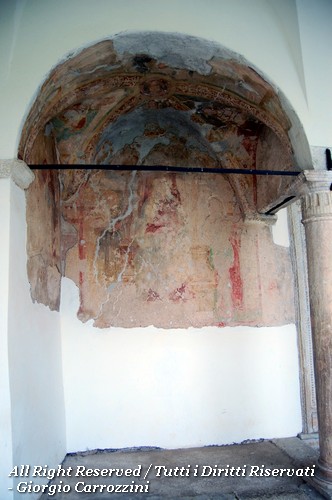
To the left of the entrance portal there is a small 16th-century shrine, frescoed in its little vault too and depicting the Madonna enthroned between Saints Roch, Benedict and Sebastian.
The interior has a stone floor with tombs and a tiled roof, supported by four large columns that divide the pitches of the two naves.
To the right of the entrance, above the holy-water stoup, traces of 15th-century frescoes in which a Madonna enthroned can be made out; on the left a flight of stairs leading up to the bell tower, under which stands the old baptismal font, taken apart.
The right-hand wall preserves an interesting cycle of paintings divided into two registers: the upper one, from 1 176, is divided into five panels, between twisted columns, depicting some episodes from the life of the Madonna; in the centre is a Madonna enthroned with Child, on the left the Birth and the Presentation of Mary at the Temple, on the right the Annunciation and the Marriage of the Virgin. In the lower register, on the other hand, there is a series of ex-votos, also from the 15th century, with various
Madonnas with Child and other saints including St James, St Sebastian, St Thomas Aquinas; other votive frescoes can also be seen around the side door: St Clare, St Roch, St Sebastian, St Francis, St Thomas Aquinas.
On the left-hand wall, as well as some traces of fresco, there is the masonry altar dedicated to Saints Roch and Sebastian, adorned with niches and their wooden statues, at the top of which God the Father and the Annunciation are depicted.
On the last column, between the two vaulted chapels of the presbytery, a Crucifixion from 1521 is depicted.
The left-hand chapel of the presbytery has on its altar a 15th-century marble shrine, inside which a wooden tabernacle from 1511 has been placed, perhaps the work of the Seneca family of Piedivalle, made to house the Madonna Bianca, a 15th-century high relief attributed to the school of Sansovino.
This tabernacle also has doors, again from 1511, painted on both sides and attributed to Giovanni Battista da Affida, showing two adoring Angels when the doors are open and the apostles Peter and John when they are closed.
The right-hand chapel, instead, houses above the altar a wooden structure from 1513 made up of a cymatium and a square niche with a 16th-century Crucifix, also fitted with decorated doors that close it.
A typical example of how widespread the cult of Mary was among the Monti Sibillini. We liked it very much for the simplicity of the place, for the care and devotion of its parishioners, who decorate the church with flowers they grow themselves.
We have chosen not to show you photos of the interior, to encourage you to go and visit and discover this wonderful church, still very well kept today (2011).
Photo gallery

Fact sheet
- Apennine area
- Central Apennines
- Italian region
- Umbria
- Province
- PG
- Municipality
- Norcia
- Notes
- A few minutes to visit it. Best in spring.
- Posizione del Luogo