The mountain pine is a pioneer plant and very “elastic”. Its hardiness and shrubby habit make it very useful for slope conservation projects in mountain areas and for protection against avalanches.
It's a microthermal species (it needs low temperatures), but it manages to reach ...
To understand the environment it grows in, read the fact sheet on the subalpine belt.
Photo gallery
Fact sheet
- Range and distribution
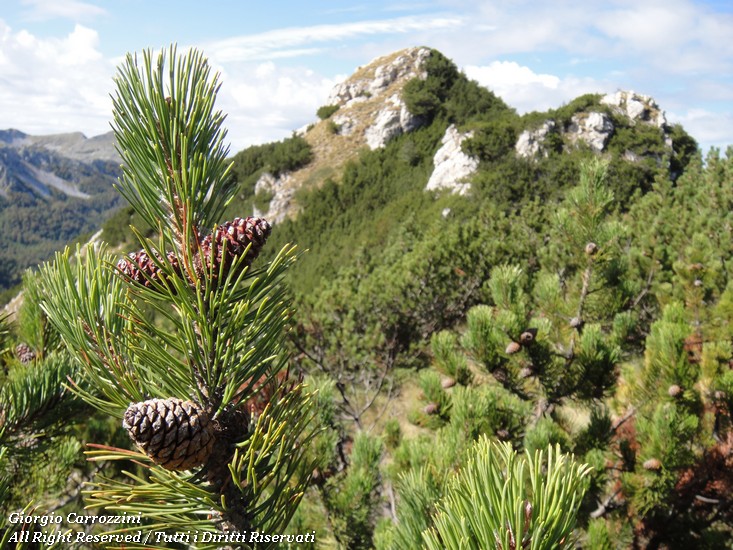
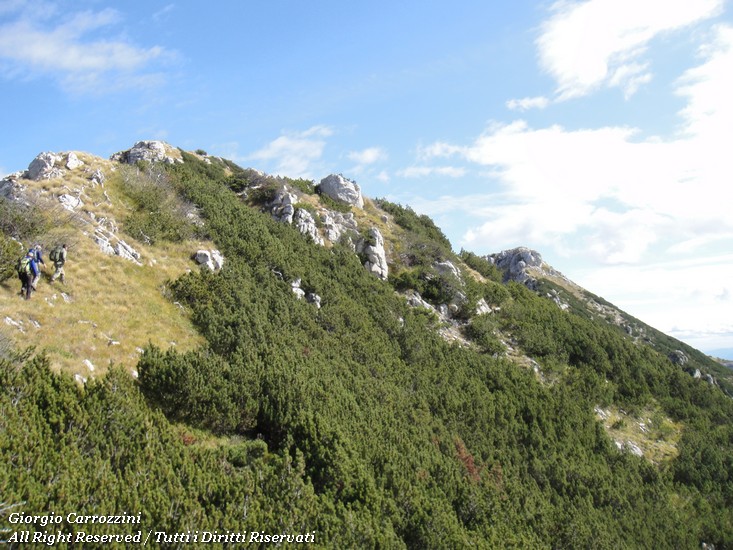
- It forms thickets, scrub and clumps on the mountains of central and eastern Europe above the upper limit of the forest. In Italy the range of the mountain pine extends in the Alpine zone beyond the beech woods, at the limit of tree vegetation (1800 – 2200 m a.s.l.). It's found in the Maritime Alps and in Piedmont, up to a compact range in the central and eastern Alps. It's also found in Abruzzo as a relic, a testimony of the ancient glaciations. It grows between 1800 and 2300 m a.s.l., in places where snowfall is very heavy, such as on the northern side of the Majella, in the Abruzzo National Park and in the Gran Sasso e Monti della Laga National Park.
- Ecology
The mountain pine is a pioneer plant and very “elastic”. It's a microthermal species (it needs low temperatures), but it manages to grow lower down, in terms of altitude, than the Swiss stone pine. It's frugal and resistant even to soils that contain toxic quantities of mineral elements. It's often associated with carbonate soils, but not exclusively. It's a xerophilous species (resistant to drought) but it's also found on peat bogs. It's a heliophilous (light-loving) species. But unlike the other pioneer species, it manages to persist when the woodland begins to evolve. That is, when, thanks to the pioneer plants, the soil becomes richer in humus and nutrients and less subject to erosion, the more demanding species move in and generally replace the pioneer species, because of the changed soil conditions and the greater shade. The mountain pine still manages to persist when these processes set in. In the Apennines, at the time of the glaciations, it represented the most evolved stage of high-altitude scrub and its range was much wider. But changed environmental conditions and heavy use by shepherds as fuel have made it retreat to very restricted areas. However, where it is present it shows no signs of decline. It appears as a stable association with phases of erosion and rebuilding, keeping the different formations in a phase of rejuvenation. Mountain pine scrub consists of a very abundant dominant layer of mountain pine and has no shrub layer, unlike the Alpine formations, where it is found with heather, bilberry and rhododendron.
- Habit
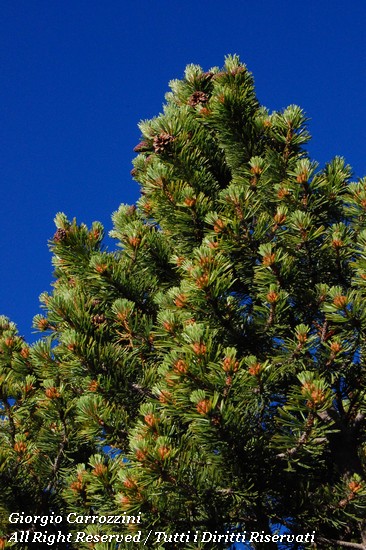
It has a creeping or shrubby habit (up to 2-4 m). The mountain pine forms compact thickets because its creeping branches put down roots in the ground.
- Leaves
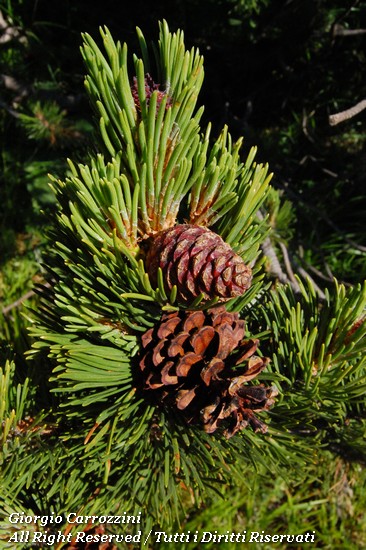
The dark green, needle-like leaves, 3 to 8 cm long, stiff and short, are grouped in pairs with a long sheath. The buds are cylindrical, blunt and resinous.
- Flowers and fruit
Flowering takes place between late May and July. The male flowers, yellow-orange, are grouped in dense inflorescences at the base of the new shoots; the female flowers, purplish dark red, are gathered at the tips of the new branches. The cones are 2.5 to 5 cm long, and their lower scales have a backward-curving spine.
- Bark
Grey-brown and scaly.
- Uses
- Its hardiness and shrubby habit make it very useful for slope conservation projects in mountain areas and for protection against avalanches The shoots and the cones that are not yet green are used to make a liqueur with balsamic and antiseptic properties.