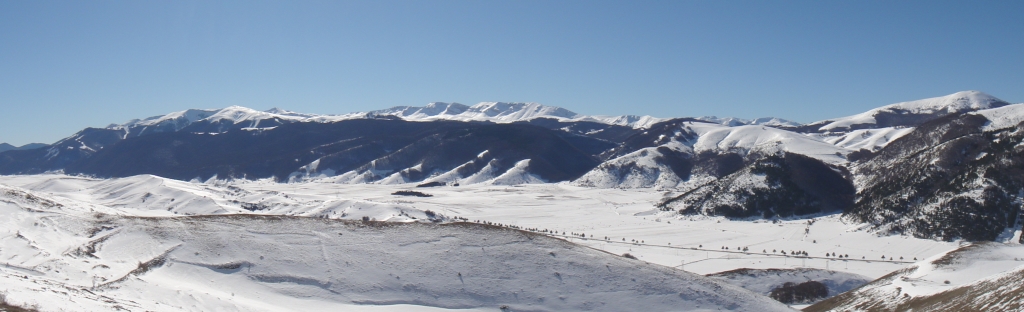
The mountains are a classic subject of landscape photography, certainly fascinating and of sure aesthetic appeal. But why do we like landscape photographs stretched out horizontally in their proportions so much?
The reason is very simple and depends on a strictly biological factor.
Our eyes are set next to each other on a horizontal axis. This natural arrangement of the eyes makes us perceive horizontally arranged images more easily than vertically arranged ones. Just notice how much more pleasant it can be to look at a photograph arranged horizontally than at a similar one with its longer axis arranged vertically.
We have often gone back to look at our photographs and had the feeling that the picture was somehow “closed”, “cut off”, “repressed”; this is because with ordinary 35 mm lenses (especially those of digital cameras) we cannot fit a wide landscape into a single frame, which is why wide-angle lenses are irreplaceable in landscape photography. This kind of lens, which can be fitted only on reflex cameras, makes the job easier when you want to bring out the vastness of open spaces or, more simply, fit a wide panorama into a single frame. Unfortunately the drawback of the wide-angle lens is that it produces a strange curving effect on the horizon line, or on objects in the landscape, a curvature that is not always aesthetically pleasing.
There are now digital cameras with handy programs able to generate large panoramic photos with a single shot. The results are often very interesting.
As for panoramic photography in the Apennines, it must be said that a panoramic photo often flattens the summits. In fact in the Apennines, where the differences in height between the peaks are much more modest than in other mountain ranges, panoramic photography risks making the view even flatter and softer. Certainly panoramic photography, used properly, can bring out, for example, the depth of some valleys. Panoramic photography used vertically (and not only horizontally) lets you photograph a valley from top to bottom, bringing out its depth.
We recommend cameras with panoramic programs that produce a panoramic photo with a single shot. We advise against cameras with the so-called Stitch Assist, programs to be installed on a computer that let you stitch the photograph together only at a later stage. These programs are slow and laborious and require post-processing that is often tedious. And if you are in the habit of taking lots of photos, you risk wasting a heap of time stitching photos back together.
Further reading:
- Guida alla Fotografia - Carlo delle Cese - Arnoldo Mondadori (1982)
- Fotografia digitale - Ben Long - Apogeo (2002)
- Come si fa una fotografia digitale - Enzo Borri - Tecniche nuove (2004)