For the photographer, nature is the most fascinating, varied subject, the richest in aspects. The main gift for those who want to devote themselves to nature photography is a spirit of observation, the ability to see the many things that are all around us. If on the one hand our cities deprive us of nature, of the “sense of the wild”, on the other there is no need to go to the other side of the world to find interesting subjects in nature. Even just a pond, a blade of grass, ants marching in single file across a meadow can give much more than an anonymous hillside panorama. Very often it is enough to get closer to the subject, to kneel down, to find a new and original perspective. When you see something “interesting” it is not enough to frame and shoot: you have to walk round the subject, understand which detail it is that interests you, imagine in your mind how the photo will turn out once the extraneous and distracting elements have been eliminated.
Another characteristic of the good photographer is certainly patience. Often, when photographing animals, that unrepeatable moment made of movement, sudden reactions or lightning-fast dashes has to be seized on the fly.
A short vade mecum for nature photography enthusiasts:
- Walk, get off the beaten track, always look for the new perspective, the unusual glimpse, the best light and conditions, because you have to know how to give luck a helping hand.
- Know how to wait, be patient, observe the subject carefully before shooting.
- If on the one hand you need to be patient, you also need to be ready to shoot, catching a reflection, a ray of light, a particular atmosphere that can turn a banal photo into a great photograph. Here digital cameras help us, letting us take a large number of photos. Don't hesitate to shoot even in difficult light.
- Always carry your camera with you: the good photographer never leaves the tool of the trade at home, come rain or shine. A ray of sunshine between the clouds or a stormy sky make excellent subjects for a photograph.
- "Shoot, shoot, shoot..." is perhaps the most important tip. Only experience lets you master your equipment and so concentrate solely on the subject in the frame.
- Look back over your photographs often and think about which mistakes you made in producing the bad ones.
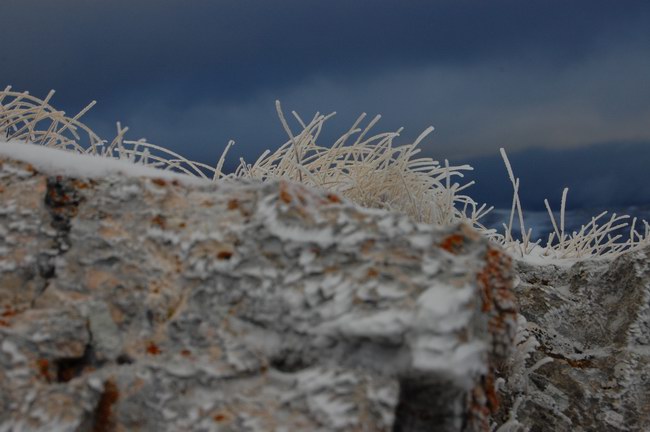
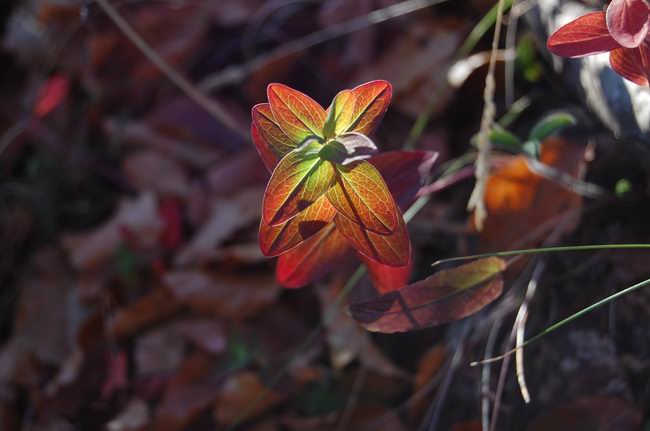
The two photographs below were taken at two particular moments. The first photograph was taken at dawn in the middle of a wood: a ray of sunlight was filtering through, striking by chance a little tuft of grass in autumn colours. The second photograph was taken as a thunderstorm was approaching, high in the mountains at about 2000 metres. You can see the three planes that make up the photo: the blurred rock, the frozen grasses brought into focus by the lens, and the threatening sky that has no need to be in focus. The dark sky provides just the right contrast to bring out the shape of the grasses and the hoar frost on them.
The photographer's right tools:
A mistake often made by the inexperienced photographer is to produce a photograph composed of too many elements arranged haphazardly. A frame that is too wide and does not focus attention on any element in particular risks becoming a jumble of disconnected elements. When you take the shot it is certainly better to tighten the frame on single subjects, trying to ennoble their features, outlines, shapes and colour.
In this sense, knowing which tools to use to “ennoble” a subject is one of the skills the good photographer must have.
If you have opted for an automatic digital camera, the possibilities are limited to the number of functions provided by the manufacturer: choice of automatic or manual shooting, exposure adjustment, flash off or on.
If you have opted for a reflex camera, here you can let your imagination run wild with the choice of the lenses you like best. Today the market offers a wide range of excellent products and digital reflex cameras at prices many can afford. As a basic lens a 50 millimetre is usually recommended. This type of lens lets you get to within a few centimetres of the subject, and you can even take very good macro photographs. This lens can also be used for panoramic shots and landscape photography. For some photos of details where you want to isolate a particular object, it is better to use an 80-200 zoom or, better still, a 135 telephoto. For very close-up photos an extension tube is also useful, which among other things lets you clearly isolate the subject by blurring the background. This is because the main problem with a badly taken photo is precisely that of scattering the subject in a sea of unblurred background objects.
For those who would rather enjoy stalking wild animals, it is essential to equip yourself with two essential tools (besides patience): a more powerful telephoto lens (from 300 millimetres upwards) and a tripod to steady the camera. There are three-legged tripods and portable single-leg ones (monopods), which at least let you hold the camera without it swaying constantly and running the risk of taking the classic “shaky” photo.
We have said that to compose a good photograph you need to isolate a subject by blurring the background. Another essential tip for composing a good photograph is to use a telephoto lens that lets you keep a certain distance from the subject. This is useful to avoid influencing and altering the spontaneity of certain situations. Being too close to a subject means altering the lighting environment and, in the case of animal photography, risking frightening the animals themselves.
Nature's subjects:
- Landscapes: mountains, countryside and hills, farmland, deserts, woods and meadows.
- Flora: trees, flowers, grasses and shrubs, mosses, fungi and lichens.
- Fauna: large animals, insects and small animals.
- Inert matter: rocks, stones, rock faces, minerals, sands and barren soils.
- Water: rivers, lakes, streams, ponds, puddles of water, waterfalls.
Nature is rich in subjects; the list above certainly does not do justice to the variety and imagination nature has been able to show off. Surely the right mix of patience, curiosity and searching can help you find those so unexpectedly interesting subjects.
Photo gallery