The spice that comes from afar…
If you have looked for information on saffron you will certainly have come across the usual Wikipedia page, perhaps too academic, perhaps too full of facts to give you any culinary ideas.
Well, we had a few problems with … “classification”, since saffron lends itself to various classifications. We could have classified it in an ideal catalogue of spices, or in a botanical list of medicinal plants, or again we could have put it in an index of recipes that use it.
However, our aim is certainly not to put knowledge in order but rather to whet the appetite of our mountain friends, who are certainly not short of appetite.
But let's go briefly back to the origins of saffron: this plant comes from Asia Minor, from the Middle Eastern area of ancient Persia. Today it is widespread and grown in almost every part of the world, in particular in the Indian subcontinent and in the Arabian peninsula. It is precisely in these regions that saffron is in common use, being used in everyday recipes.
In Italy the growing of saffron is typical of the mountain areas of the central Apennines.
Just think how famous the selection of the bulbs, the growing and the harvesting (still done entirely by hand) of saffron on the Navelli plateau are. Zafferano dell'Aquila (Crocus Sativus L. cv Piano di Navelli) is characterised by the length of its stigmas, by its high content of safranal, the chemical substance that determines its aromatic power, and by its high colouring power.
But it would be enough to mention the saffron of Cascia and of San Gimignano too. Crocus sativus L. finds its ideal habitat on the plateaus of central Italy thanks to a mix of favourable factors: highly permeable limestone soils (the crocus does not tolerate standing water), medium-high rainfall and winter temperatures that are not too harsh.
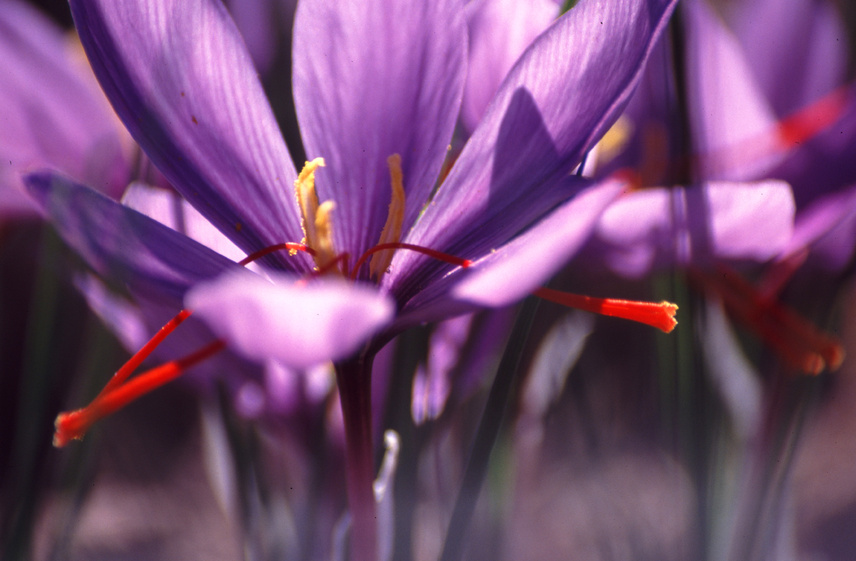 In Abruzzo this refinedly aromatic spice is certainly a source of income for mountain farming. Bear in mind that saffron can reach prices of over 3000 euros a kilo. This price is due to two essential reasons: on the one hand the difficulty of growing the plant (very specific growing requirements); secondly, it should be considered that, for a better-quality product, manual work is preferred throughout the whole production process, from selecting the bulbs to harvesting the flowers, from which only the stigmas are extracted. It should be remembered that true saffron, the one that gives the most genuine aroma, is precisely the one you can buy in its natural form, that is, the dried stigmas. It would be better to be wary of the cheaper saffron powder, sometimes produced from processing waste or even made with artificial flavourings and colourings.
Recipes with the aroma of saffron are numerous and range from first courses right up to desserts: just think of “gnocchetti with speck and saffron”, a typical recipe of Trentino Alto Adige, or its Abruzzo version “gnocchi with Navelli saffron”, rabbit or chicken with saffron, right up to Abruzzo ferratelle (wafer biscuits) with saffron.
For the greediest among you we want to give the recipe for “mozzarella in carrozza with saffron”, a simple dish within everyone's reach.
CRISPY SAFFRON MOZZARELLA
Serves 4
Ingredients
- 2 large Abruzzo mozzarellas or, alternatively, 8-10 small ciliegine (cherry-sized mozzarellas)
- saffron stigmas
- flour and breadcrumbs
- oil for frying
- salt to taste
- water
Cut the large mozzarellas into 4 wide slices more or less 1.5 centimetres thick. The result will be even better if you decide to use the ciliegine. Make a batter of water, flour, salt and, naturally, saffron. Dip the pieces in the batter. On a separate plate you will already have prepared the breadcrumbs. Coat the battered mozzarella in the breadcrumbs too and straight away fry each piece briefly in the very hot oil. The pieces obtained in this way should, if possible, be served hot to keep the batter crisp.
Among the villages in the province of L'Aquila, Rocca Calascio is also well worth a visit.